Barbell Back Squat
A foundational lower-body lift. With a barbell across your upper back, you sit your hips down between your heels and stand back up.
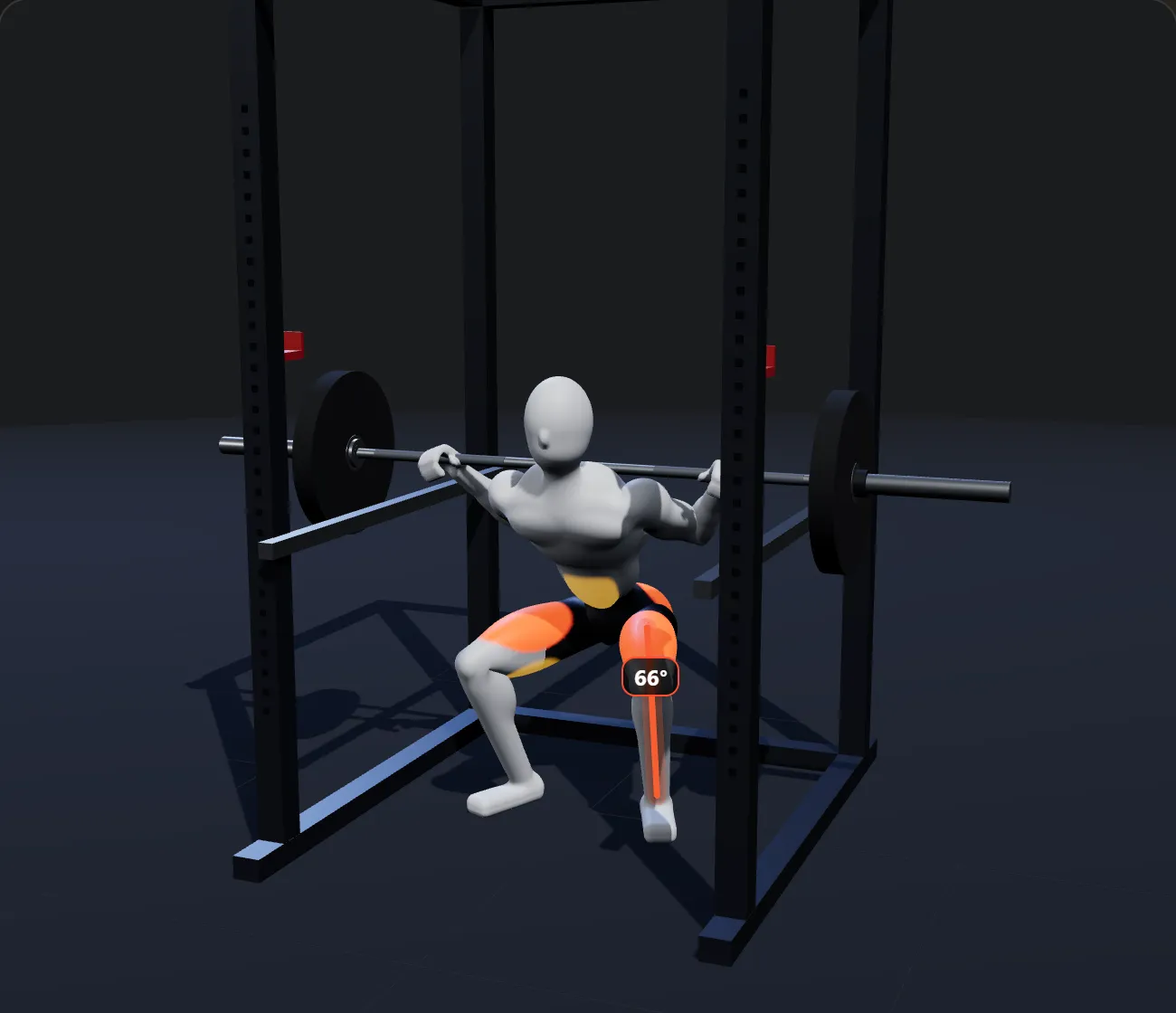
Brace, then sit your hips down and back
Loading 3D viewer…
How to do it
- Set the bar in a rack at about chest height. Step under it so it rests across your upper back, below the bony point at the base of your neck.
- Grip the bar just outside your shoulders, lift it out of the rack, and take two or three steps back. Set your feet about shoulder-width apart with your toes turned slightly out.
- Take a deep breath and brace your core. Push your hips back and bend your knees at the same time, keeping your knees in line with your toes.
- Lower until your thighs are at least parallel to the floor, or as deep as you can go while keeping your back neutral and heels down.
- Drive up through your whole foot to stand, keeping your chest up so your hips and shoulders rise together.
Common mistakes
- Knees caving inward on the way up. Push them out over your toes.
- Heels lifting off the floor, which shifts the load onto the front of the knee.
- Hips shooting up faster than your chest, turning the squat into a good-morning.
- Losing your brace at the bottom and letting the lower back round.
Sets and reps
| Goal | Sets | Reps | Rest |
|---|---|---|---|
| Starting out | 2–3 | 8–10 | 2 min |
| Strength | 3–5 | 3–6 | 3–5 min |
| Muscle size | 3–4 | 6–12 | 2–3 min |
Squats tire your whole body, so do them first in a session. Add weight only when every rep reaches the same depth with your knees tracking over your toes; as a beginner, small jumps of 2.5–5 kg (5–10 lb) add up quickly.
These are starting points for healthy adults. End each set with a little left in the tank, and move up once you reach the top of a range. The research behind them: How Many Sets and Reps? and How Long to Rest Between Sets.
Variations
- Goblet squat: One weight held at your chest keeps your torso upright and teaches depth. The usual first step before a barbell.
- Front squat: The bar rests on the front of your shoulders. You stay more upright, and your quads and upper back do more of the work.
- Box squat: You sit back to a box or bench at a set height on every rep, which teaches depth and control.
The animation shows general technique, not advice for your body. If you have an injury or are new to lifting, check your form with a qualified coach. See the Disclaimer.
Plan your training
- One Rep Max Calculator →
Estimate your max on a barbell lift from a set of reps, with training weights by percentage.
- Barbell Plate Calculator →
Work out which plates to load on each side for your working weight.
- Progressive Overload: The Science of Getting Stronger →
How muscles adapt, heavy versus light loads, and how fast to add weight.
- Sore Muscles After a Workout: The Science of DOMS →
Why muscles ache a day or two after training, and what actually helps.
- Protein Intake Calculator →
Find how much protein you need a day to recover from training and build muscle.
Related exercises
Kettlebell Goblet Squat
A beginner-friendly squat. Holding a kettlebell at your chest keeps your torso upright and makes it easier to sit deep between your heels.
View in 3D →Dumbbell Lunge
A split-stance leg exercise for the quads and glutes. Holding dumbbells at your sides, you lower your back knee toward the floor and drive back up through your front foot. This is the stationary version, with your feet planted.
View in 3D →Barbell Deadlift
The classic full-body pull. With a flat back and the bar against your shins, you stand up with a loaded barbell from the floor, driving through your legs and hips.
View in 3D →