Progressive Overload: The Science of Getting Stronger
How muscles adapt to lifting, how an army doctor turned heavy lifting into medicine, heavy versus light loads, how fast to add weight, and why strength training pays off for health.
7 min read · Published September 18, 2026
At a glance
- Muscles adapt to the demands you place on them. To keep getting stronger, those demands have to rise gradually — the principle of progressive overload.
- The idea was put on a scientific footing in 1945 by the US Army physician Thomas DeLorme, who used steadily heavier lifts to rehabilitate injured soldiers.
- You can progress by adding weight or by adding reps, and both build muscle. Heavy loads are best for maximal strength, but muscle growth is similar across a wide range of loads.
- Just 30–60 minutes of muscle-strengthening activity a week is linked to a 10–20% lower risk of early death, and weight training has relatively low injury rates.
The first time you lift a weight, it feels heavy. A few weeks later, the same weight feels easy. Your body has adapted, and if you keep lifting that weight, it will stay easy — and you’ll stop improving. The fix is one of the oldest and most reliable principles in exercise science: progressive overload. Give your muscles a little more to do over time, and they keep adapting.
A brief history: from Milo’s calf to army hospitals
The idea is often traced to an ancient Greek legend. Milo of Croton, a famous wrestler of the 6th century BCE, is said to have carried a newborn calf on his shoulders every day. As the calf grew into a bull, his strength grew with it. It’s a story rather than history, but it captures the principle perfectly: a load that increases a little at a time.
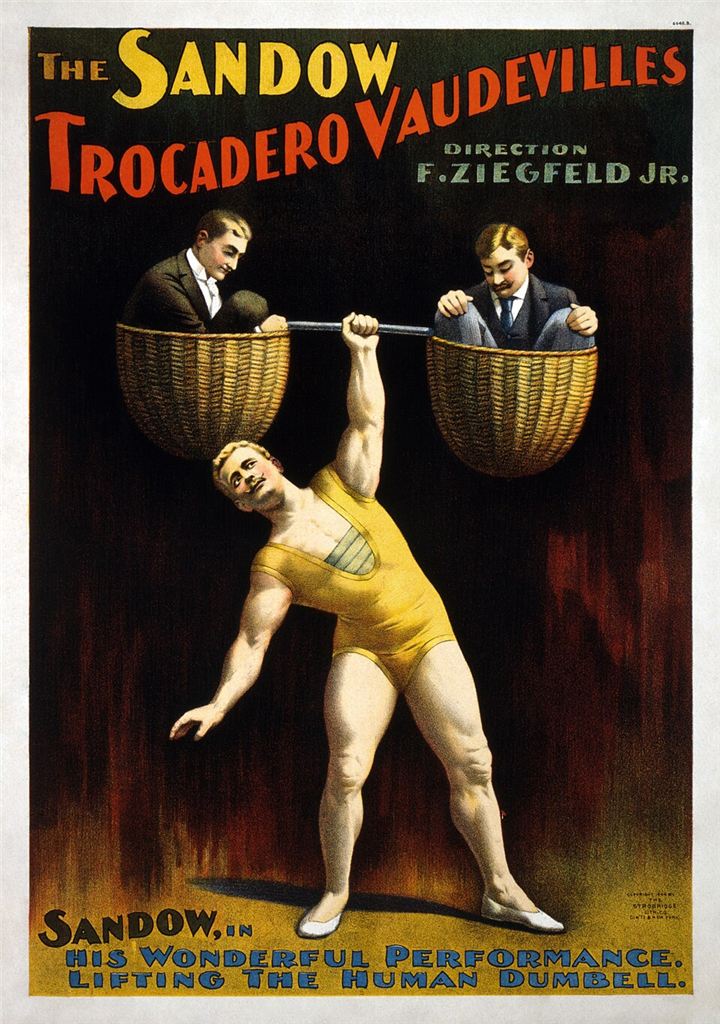
By the late 1800s, strongmen had turned lifting into popular entertainment. The Prussian-born performer Eugen Sandow toured theaters showing off feats of strength and a sculpted physique, and he is often called the father of modern bodybuilding. Weightlifting was contested at the first modern Olympic Games in 1896. But lifting weights was widely viewed as a stunt for performers, not a serious form of exercise or therapy.
That changed during World War II. Thomas DeLorme, a young US Army physician who had used strength training himself to recover from a childhood illness, was treating soldiers with knee injuries. The standard approach used light weights and many repetitions. DeLorme instead had patients lift heavy loads for sets of about ten repetitions and increase the weight as they got stronger. His results, published in 1945 in the Journal of Bone and Joint Surgery, were striking, and he later formalized the method as “progressive resistance exercise” — the ancestor of the three sets of ten still used in gyms today[1, 2].
How muscles adapt
Strength training works because your body responds to stress by becoming better able to handle it. In the first weeks, much of the gain in strength comes from your nervous system learning to use your muscles more effectively: recruiting more muscle fibers and coordinating them better. Over the following months, the muscle fibers themselves grow larger. Tendons, ligaments, and bones adapt more slowly but strengthen too.
All of these adaptations respond to a challenge. Once a load stops being challenging, the stimulus to adapt fades. That’s why the American College of Sports Medicine’s guidelines on resistance training are built around progression. For beginners, they recommend loads you can lift for about 8–12 repetitions, two to three days a week, and they suggest increasing the load by 2–10% once you can do one or two repetitions more than your target[3].
Heavy or light? What the research says
For years, people assumed that you had to lift heavy to build muscle. The evidence is more nuanced. A 2017 meta-analysis of 21 studies compared training with light loads (60% or less of a person’s one-rep maximum) and heavy loads, with every set taken to the point of muscular failure. Heavy loads produced bigger gains in maximal strength, but gains in muscle size were similar with light and heavy loads[4].
The practical lesson: if your main goal is to lift as much as possible, you need to practice with heavy weights. If you want to build muscle and general strength, a wide range of loads works, as long as your sets are hard. Some of these studies took every set to failure, which isn’t necessary for most people; finishing sets with a rep or two “in the tank” is a common, sensible approach.
The amount of work matters too. A meta-analysis of 15 studies found a dose-response relationship between weekly training volume and muscle growth: each additional weekly set per muscle was linked to slightly larger gains[5]. More isn’t endlessly better, and beginners grow well on modest volumes, but gradually adding sets is another way to progress.
Adding weight versus adding reps
Progressive overload doesn’t have to mean adding weight every session. In a 2022 trial, trained lifters followed either a program that increased the load each week or one that kept the load steady and increased the number of repetitions. After eight weeks, both groups made similar gains in muscle size and strength[6]. You can progress by adding weight, adding reps, adding sets, or improving your technique and control. The common thread is that the work gets gradually harder.
When you do add weight, small steps help. A 2.5 kg jump is 10% of a 25 kg lift but only 2.5% of a 100 kg lift, so lighter lifts, especially upper-body lifts like the overhead press, often need smaller increments to stay within the 2–10% guideline. That’s why fractional plates of 1.25 kg or 0.5 kg exist.
A note on barbells and plates
Competition equipment is standardized so that weights are accurate and easy to read. Under the International Powerlifting Federation’s rules, competition plates must be within 0.25% or 10 grams of their marked weight, 25 kg plates are red, 20 kg blue, and 15 kg yellow, and the heaviest plates are loaded first, closest to the center of the bar. Each collar weighs 2.5 kg, and the bar and collars together weigh 25 kg[7]. A standard men’s bar weighs 20 kg, and a women’s Olympic weightlifting bar weighs 15 kg. Gym equipment is usually less precise, so treat the numbers on everyday plates as close approximations.
Why strength training is worth it
Muscle strength isn’t only for athletes. The World Health Organization recommends that adults do muscle-strengthening activities involving all major muscle groups on two or more days a week, alongside aerobic activity[8]. A 2022 meta-analysis of 16 studies found that muscle-strengthening activities were associated with a 10–17% lower risk of death from any cause and of heart disease, cancer, and diabetes. The greatest risk reduction for early death appeared at about 30–60 minutes a week, and combining strength and aerobic exercise was better still[9]. These are observational findings, so they can’t prove cause and effect, but they suggest that a modest amount of strength training goes a long way.
Strength training also matters for bones. In the LIFTMOR trial, 101 women past menopause with low bone mass were randomly assigned either to supervised high-intensity resistance and impact training — sets of five heavy repetitions, twice a week for eight months — or to a low-intensity home program. The lifting group increased spine bone density by 2.9% while the comparison group lost 1.2%, and physical function improved too. Only one minor injury, a back spasm, was reported[10]. Heavy lifting under good supervision was safe and effective even for people often told to avoid it.
Worried about injury? A review of injury research across the weight-training sports — weightlifting, powerlifting, bodybuilding, strongman, and others — found relatively low injury rates compared with common team sports, with bodybuilding among the lowest at about 0.24–1 injury per 1,000 hours of training[11]. The shoulders, lower back, and knees were the most commonly injured areas, which is a good reason to progress gradually and prioritize technique.
How progressive overload can benefit you
- Steady, measurable progress. Tracking your weights and reps turns vague effort into clear evidence that you’re getting stronger.
- Fewer plateaus. Small, planned increases keep your muscles adapting instead of settling into a comfortable routine.
- Lower injury risk. Gradual increases give tendons and joints time to adapt along with your muscles.
- Better body composition. Building muscle helps you look and feel leaner, and resistance training helps you keep muscle while losing fat.
Putting it into practice
Keep a simple log of each exercise, the weight, and the reps you did. When you can complete all your sets with one or two more reps than your target, add a small amount of weight next time — or add a rep or a set if a jump in weight would be too big. The Barbell Plate Calculator shows exactly which plates to load for any target weight, including whether your gym’s plates can make that weight at all.
Support your training with enough protein — our article on macronutrients covers how much — and track your progress beyond the scale with the help of our article on measuring body fat. If you’re also losing weight, see why weight loss slows down and how lifting helps protect muscle. For the cardio side of fitness, read about heart rate training. If you’re new to lifting or have a medical condition, consider starting with a qualified coach.
Try it yourself
Put the science into practice with this free tool — no sign-up, right in your browser.
References
- Todd, J. S., Shurley, J. P., & Todd, T. C. (2012). Thomas L. DeLorme and the science of progressive resistance exercise. Journal of Strength and Conditioning Research, 26(11), 2913–2923. doi:10.1519/JSC.0b013e31825adcb4
- DeLorme, T. L. (1945). Restoration of muscle power by heavy-resistance exercises. The Journal of Bone and Joint Surgery, 27(4), 645–667. Link
- American College of Sports Medicine. (2009). American College of Sports Medicine position stand: Progression models in resistance training for healthy adults. Medicine & Science in Sports & Exercise, 41(3), 687–708. doi:10.1249/MSS.0b013e3181915670
- Schoenfeld, B. J., Grgic, J., Ogborn, D., & Krieger, J. W. (2017). Strength and hypertrophy adaptations between low- vs. high-load resistance training: A systematic review and meta-analysis. Journal of Strength and Conditioning Research, 31(12), 3508–3523. doi:10.1519/JSC.0000000000002200
- Schoenfeld, B. J., Ogborn, D., & Krieger, J. W. (2017). Dose-response relationship between weekly resistance training volume and increases in muscle mass: A systematic review and meta-analysis. Journal of Sports Sciences, 35(11), 1073–1082. doi:10.1080/02640414.2016.1210197
- Plotkin, D., Coleman, M., Van Every, D., Maldonado, J., Oberlin, D., Israetel, M., Feather, J., Alto, A., Vigotsky, A. D., & Schoenfeld, B. J. (2022). Progressive overload without progressing load? The effects of load or repetition progression on muscular adaptations. PeerJ, 10, e14142. doi:10.7717/peerj.14142
- International Powerlifting Federation. (2026). Technical rulebook (effective 1 March 2026). Link
- Bull, F. C., Al-Ansari, S. S., Biddle, S., Borodulin, K., Buman, M. P., Cardon, G., et al. (2020). World Health Organization 2020 guidelines on physical activity and sedentary behaviour. British Journal of Sports Medicine, 54(24), 1451–1462. doi:10.1136/bjsports-2020-102955
- Momma, H., Kawakami, R., Honda, T., & Sawada, S. S. (2022). Muscle-strengthening activities are associated with lower risk and mortality in major non-communicable diseases: A systematic review and meta-analysis of cohort studies. British Journal of Sports Medicine, 56(13), 755–763. doi:10.1136/bjsports-2021-105061
- Watson, S. L., Weeks, B. K., Weis, L. J., Harding, A. T., Horan, S. A., & Beck, B. R. (2018). High-intensity resistance and impact training improves bone mineral density and physical function in postmenopausal women with osteopenia and osteoporosis: The LIFTMOR randomized controlled trial. Journal of Bone and Mineral Research, 33(2), 211–220. doi:10.1002/jbmr.3284
- Keogh, J. W. L., & Winwood, P. W. (2017). The epidemiology of injuries across the weight-training sports. Sports Medicine, 47(3), 479–501. doi:10.1007/s40279-016-0575-0
This article is for general education and isn’t medical advice. The exercises and calculators on this site are general wellness tools, not diagnostic tests or treatments — see the Disclaimer for details. Spotted an error or a newer study we should know about? Let us know.
More articles
- Training · 9 min readHeart Rate Training: The Science of Zones and the Karvonen Formula
- Training · 7 min readPacing Strategy: The Science of Running Your Best Race
- Reflexes · 7 min readThe Science of Reaction Time: Why Milliseconds Matter
- Eye training · 6 min readSmooth Pursuit: How Your Eyes Follow a Moving Target
- Eye training · 7 min readPeripheral Vision and Visual Attention: Seeing More Than You Look At
- Focus · 7 min readThe Schulte Table: The Science of Visual Search and Focus
- Memory · 6 min readWorking Memory: How Much Can Your Mind Hold at Once?
- Math · 6 min readMental Math: What Happens in Your Brain When You Calculate
- Breathing · 7 min readBox Breathing and 4-7-8 Breathing: The Science of Slow Breathing
- Nutrition · 7 min readProtein, Carbs, and Fat: The Science of Macronutrients
- Body composition · 7 min readMeasuring Body Fat: What the Tape, the Scale, and the Scanner Tell You
- Nutrition · 7 min readWhy Weight Loss Slows Down: The 3,500-Calorie Rule and Your Metabolism