Resistance Band Pull-Apart
A simple upper-back and rear-shoulder exercise. Holding a band at arm's length, you pull it apart until it touches your chest.
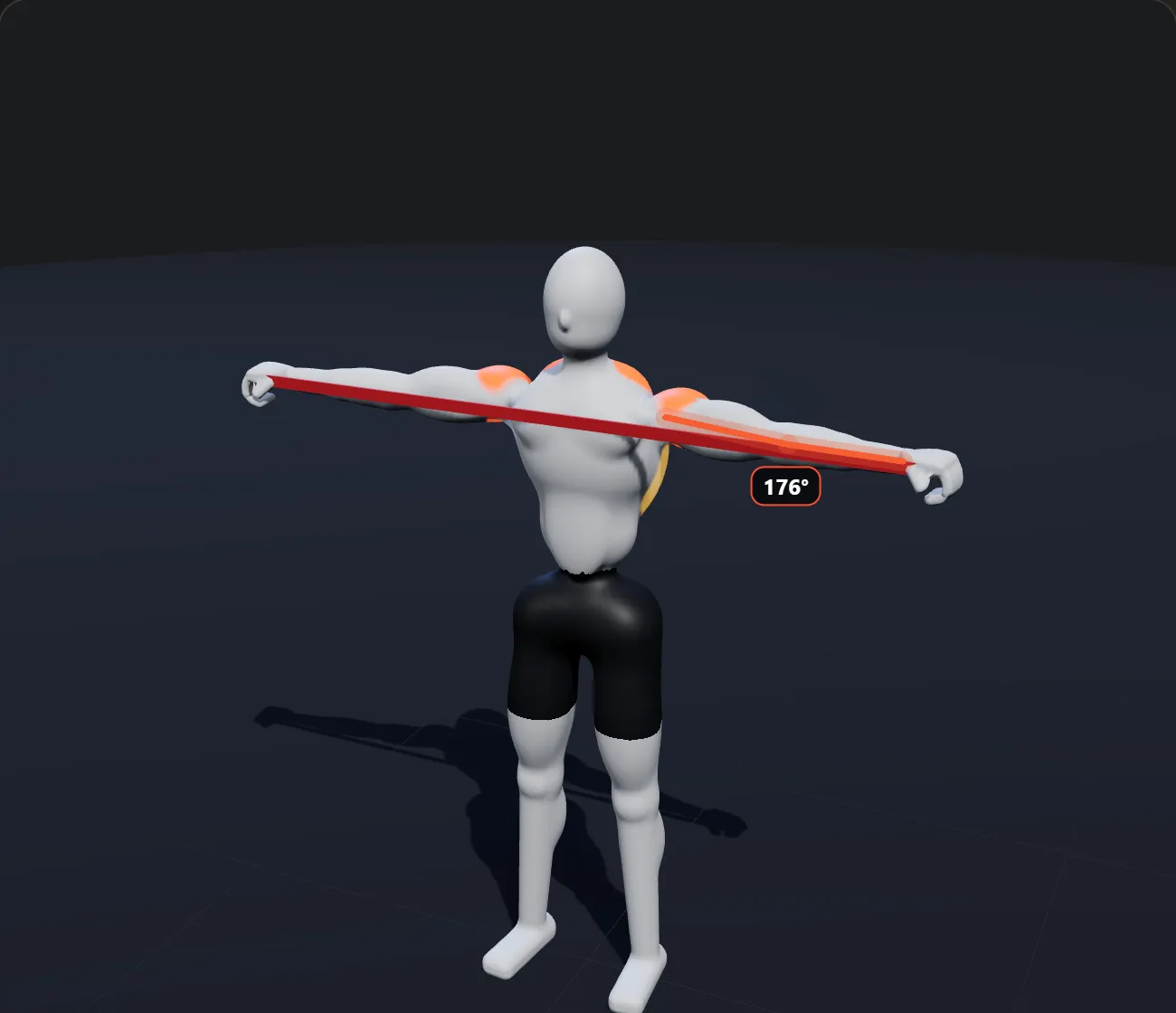
Pull the band apart, leading with your hands
Loading 3D viewer…
How to do it
- Stand tall and hold a light band in front of you at shoulder height, arms straight and hands about shoulder-width apart.
- Keep a soft bend in your elbows and your ribs down.
- Pull the band apart by moving your hands out to the sides, keeping your arms level.
- Stop when the band touches your chest and squeeze your shoulder blades together.
- Let your hands come back together slowly, keeping some tension in the band.
Common mistakes
- Shrugging your shoulders up as you pull.
- Arching your lower back to get the band wider.
- Bending your elbows so your arms do the work instead of your upper back.
- Snapping back to the start instead of controlling the return.
Sets and reps
| Goal | Sets | Reps | Rest |
|---|---|---|---|
| Warm-up | 1–2 | 15–20 | 30 s |
| Starting out | 2–3 | 12–15 | 45–60 s |
| Muscle size | 3–4 | 15–25 | 60 s |
Pull-aparts are light, so they suit high reps and frequent use; many lifters do a set or two before every pressing session. Make them harder with a stronger band or by holding the band with your hands closer together.
These are starting points for healthy adults. End each set with a little left in the tank, and move up once you reach the top of a range. The research behind them: How Many Sets and Reps? and How Long to Rest Between Sets.
Variations
- Face pull: Pull a rope from a cable or band toward your face with your elbows high. Works the same rear shoulders and upper back with more load.
- Diagonal pull-apart: One hand sweeps up and out while the other goes down and out, working the rear shoulders at a different angle.
- Reverse dumbbell fly: Hinge forward and raise light dumbbells out to your sides: the free-weight version.
The animation shows general technique, not advice for your body. If you have an injury or are new to lifting, check your form with a qualified coach. See the Disclaimer.
Plan your training
- Progressive Overload: The Science of Getting Stronger →
How muscles adapt, heavy versus light loads, and how fast to add weight.
- Sore Muscles After a Workout: The Science of DOMS →
Why muscles ache a day or two after training, and what actually helps.
- Protein Intake Calculator →
Find how much protein you need a day to recover from training and build muscle.
Related exercises
Barbell Bent-Over Row
A heavy compound pull for the whole upper back. Hinged forward with a flat back, you row a barbell from arm's length up to your lower ribs.
View in 3D →Inverted Row
A bodyweight row under a bar set at about waist height. Holding your body straight like a plank, you pull your chest up to the bar.
View in 3D →Seated Cable Row
A seated cable pull for the middle of the back. With your feet braced and torso tall, you row a close-grip handle to your stomach.
View in 3D →