Seated Cable Row
A seated cable pull for the middle of the back. With your feet braced and torso tall, you row a close-grip handle to your stomach.
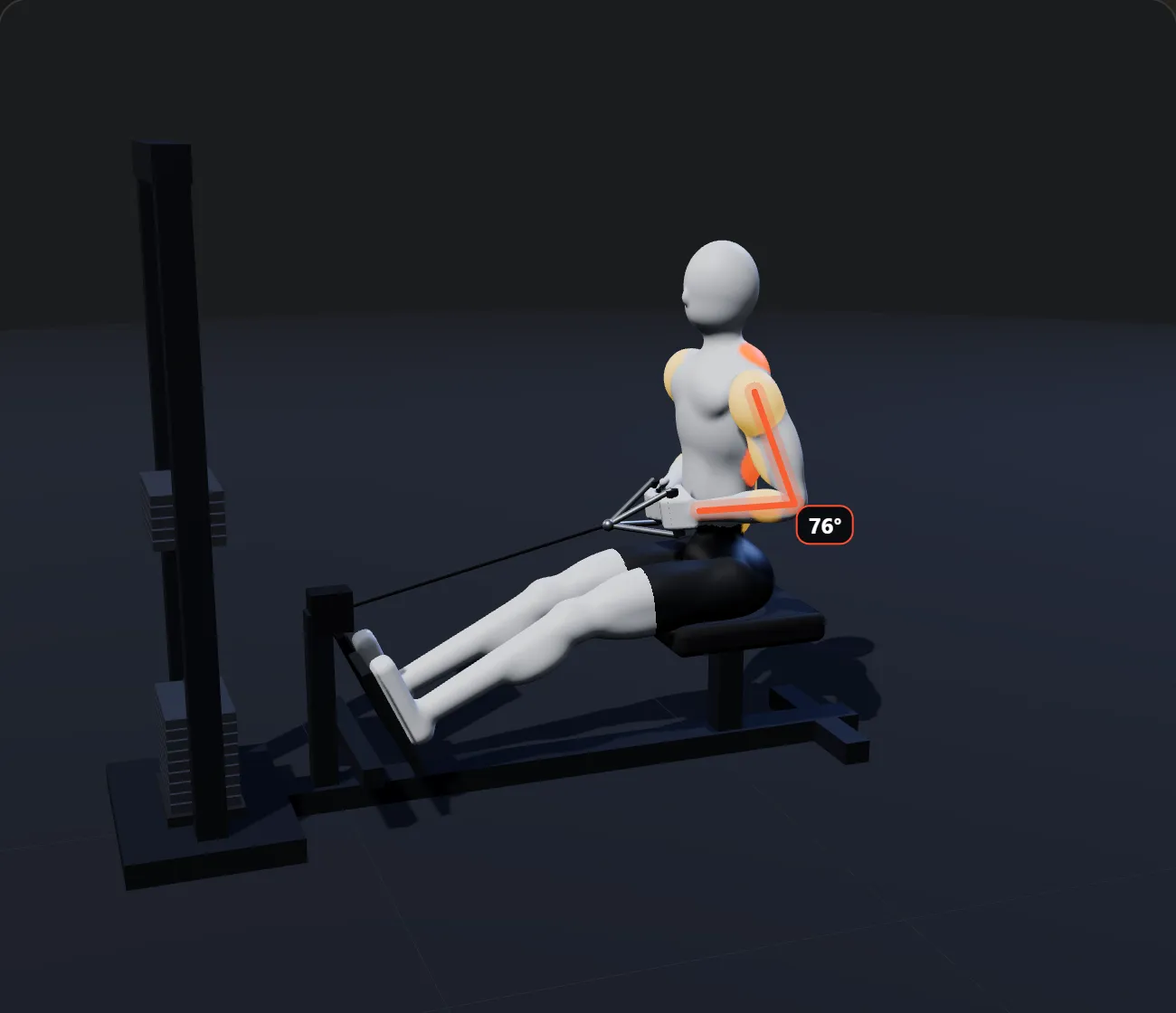
Sit tall and pull the handle to your stomach, elbows close to your sides
Loading 3D viewer…
How to do it
- Sit on the bench with your feet on the footplates and your knees slightly bent.
- Grab the V-handle with your palms facing each other and sit back with your arms straight, torso upright or tipped slightly forward from the hips.
- Brace your core and keep your back flat and your chest up.
- Pull the handle to your stomach, driving your elbows straight back close to your sides until your torso is upright.
- Squeeze your shoulder blades together, then let your arms straighten under control, letting your shoulders reach forward without rounding your back.
Common mistakes
- Rocking the torso back and forth to swing the weight.
- Rounding the lower back as the handle goes forward.
- Leaning far back past upright at the finish.
- Shrugging the shoulders up toward the ears.
- Flaring the elbows out, which shifts the work away from the lats.
Sets and reps
| Goal | Sets | Reps | Rest |
|---|---|---|---|
| Starting out | 2–3 | 10–12 | 60–90 s |
| Strength | 3–4 | 6–8 | 2 min |
| Muscle size | 3–4 | 8–12 | 1–2 min |
The weight stack lets you add weight in small steps, which suits beginners. Keep your torso still apart from a slight lean; if you have to rock back to move the weight, it's too heavy.
These are starting points for healthy adults. End each set with a little left in the tank, and move up once you reach the top of a range. The research behind them: How Many Sets and Reps? and How Long to Rest Between Sets.
Variations
- Wide-grip cable row: A long bar with an overhand grip, pulled to your upper chest. More work for the upper back and rear shoulders.
- Single-arm cable row: One handle at a time, so you can work each side on its own.
- Barbell bent-over row: The free-weight version, holding a hinge with no seat to brace against.
The animation shows general technique, not advice for your body. If you have an injury or are new to lifting, check your form with a qualified coach. See the Disclaimer.
Plan your training
- Progressive Overload: The Science of Getting Stronger →
How muscles adapt, heavy versus light loads, and how fast to add weight.
- Sore Muscles After a Workout: The Science of DOMS →
Why muscles ache a day or two after training, and what actually helps.
- Protein Intake Calculator →
Find how much protein you need a day to recover from training and build muscle.
Related exercises
Barbell Bent-Over Row
A heavy compound pull for the whole upper back. Hinged forward with a flat back, you row a barbell from arm's length up to your lower ribs.
View in 3D →Inverted Row
A bodyweight row under a bar set at about waist height. Holding your body straight like a plank, you pull your chest up to the bar.
View in 3D →Pull-Up
The classic bodyweight back exercise. Hanging from a bar with an overhand grip, you pull your chin up over the bar and lower yourself back down.
View in 3D →