Barbell Bench Press
The classic chest builder. Lying on a flat bench, you lower a barbell to your lower chest with your elbows tucked, then press it back up over your shoulders.
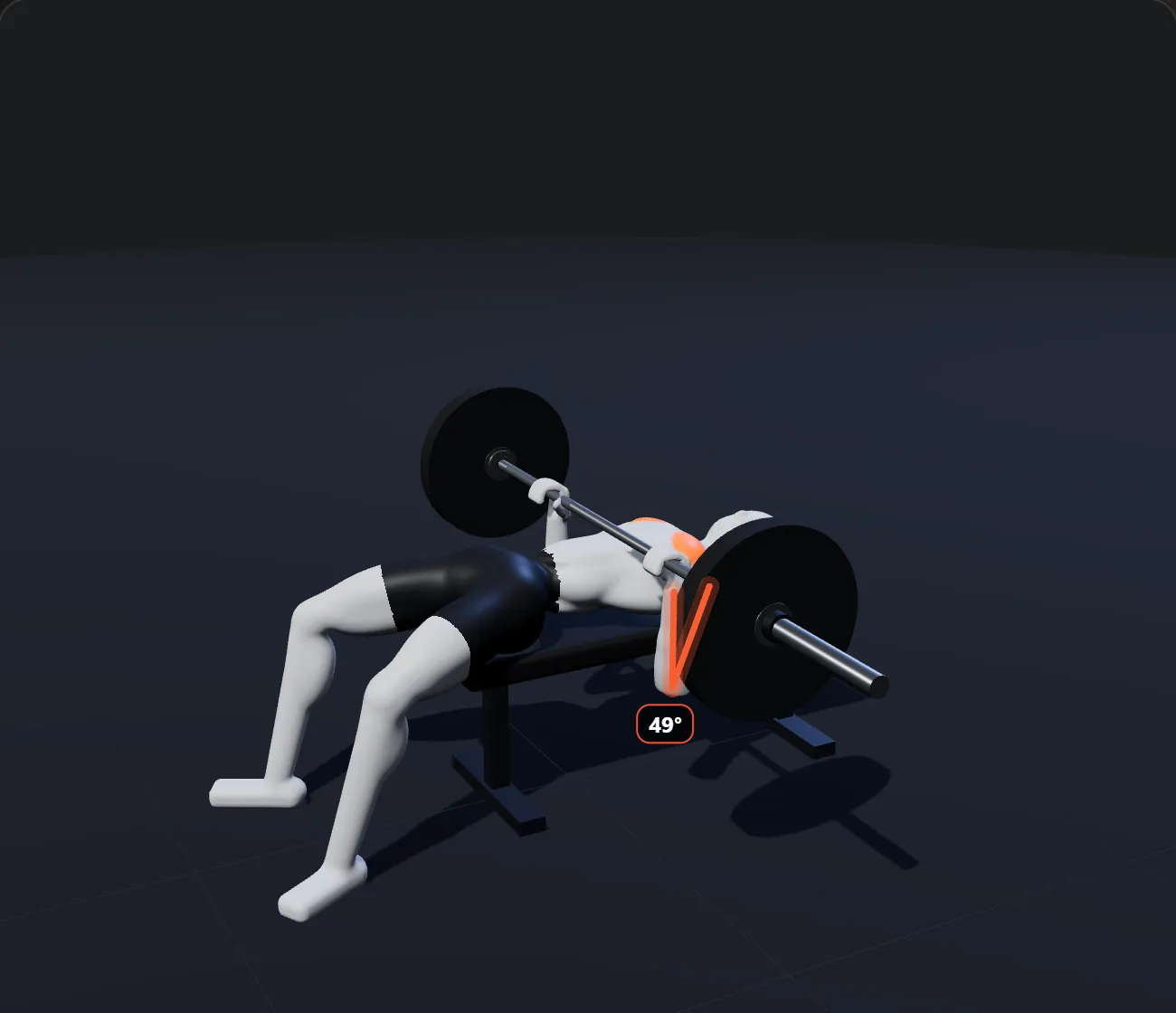
Lower the bar to your lower chest, elbows tucked about 45°
Loading 3D viewer…
How to do it
- Lie on a flat bench with your eyes under the bar. Plant your feet flat on the floor, a little wider than your hips.
- Grip the bar with your hands a hand-width or two outside your shoulders, so your forearms will be vertical at the bottom.
- Pull your shoulder blades back and down into the bench, keeping your glutes and upper back on it with a slight arch in your lower back.
- Unrack the bar and hold it over your shoulders with straight arms.
- Lower it under control to your lower chest, elbows tucked about 45–60° from your sides.
- Touch lightly without bouncing, then press the bar up and slightly back until it is over your shoulders again.
Common mistakes
- Flaring the elbows straight out to 90°, which loads the front of the shoulder.
- Bouncing the bar off the chest instead of touching and pressing under control.
- Lifting your hips off the bench to push the bar up.
- Letting the shoulder blades drift apart so the shoulders roll forward.
- Gripping so wide or so narrow that the forearms tilt at the bottom.
- Benching heavy without a spotter or safety arms.
Sets and reps
| Goal | Sets | Reps | Rest |
|---|---|---|---|
| Starting out | 2–3 | 8–10 | 2 min |
| Strength | 3–5 | 3–6 | 3–5 min |
| Muscle size | 3–4 | 6–12 | 2–3 min |
Before you go heavy, set the rack's safety arms just below the bar's lowest point or use a spotter, since a missed rep can pin you. Keep your elbows tucked 45–60° from your sides on every rep, the first as much as the last.
These are starting points for healthy adults. End each set with a little left in the tank, and move up once you reach the top of a range. The research behind them: How Many Sets and Reps? and How Long to Rest Between Sets.
Variations
- Dumbbell bench press: Each arm works on its own through a longer range of motion. Often easier on the shoulders.
- Incline dumbbell press: The bench raised to about 30° shifts more of the work to the upper chest.
- Close-grip bench press: Hands about shoulder-width apart, which shifts more of the work to the triceps.
- Push-up: The same pressing pattern with your body weight and no equipment.
The animation shows general technique, not advice for your body. If you have an injury or are new to lifting, check your form with a qualified coach. See the Disclaimer.
Plan your training
- One Rep Max Calculator →
Estimate your max on a barbell lift from a set of reps, with training weights by percentage.
- Barbell Plate Calculator →
Work out which plates to load on each side for your working weight.
- Progressive Overload: The Science of Getting Stronger →
How muscles adapt, heavy versus light loads, and how fast to add weight.
- Sore Muscles After a Workout: The Science of DOMS →
Why muscles ache a day or two after training, and what actually helps.
- Protein Intake Calculator →
Find how much protein you need a day to recover from training and build muscle.
Related exercises
Push-Up
The classic bodyweight chest exercise. Holding your body in one straight line, you lower your chest toward the floor and push back up.
View in 3D →Parallel Bar Dip
A bodyweight push for the chest and triceps. Supported on two bars, you lower your body by bending your elbows, then press back up to straight arms.
View in 3D →Dumbbell Bench Press
A flat-bench chest press with a dumbbell in each hand. Each arm works on its own, and the hands can travel a little further than with a barbell.
View in 3D →