Push-Up
The classic bodyweight chest exercise. Holding your body in one straight line, you lower your chest toward the floor and push back up.
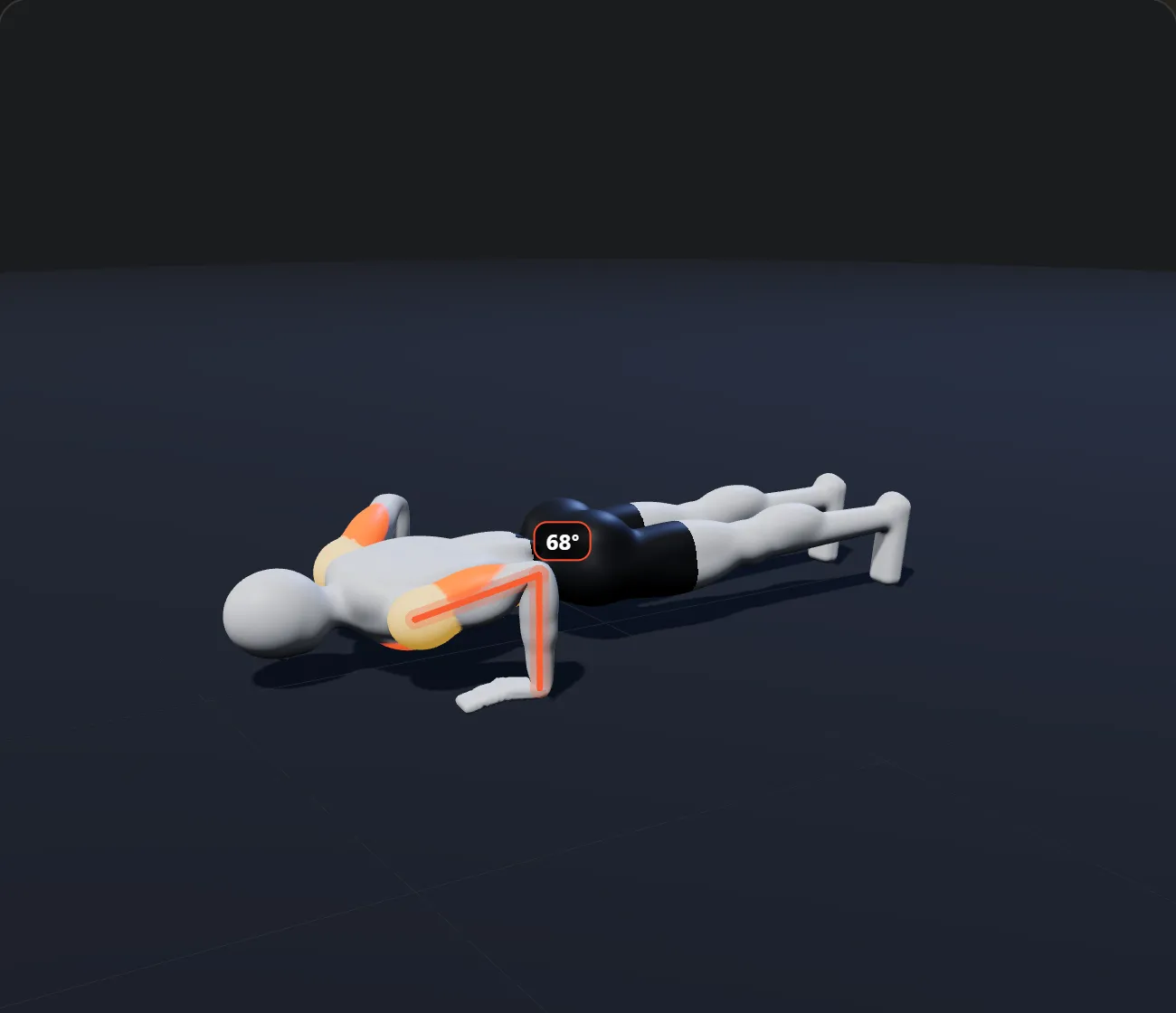
Brace, then lower your chest toward the floor
Loading 3D viewer…
How to do it
- Start on your hands and toes with your hands flat, a little wider than your shoulders and level with your lower chest, fingers pointing forward.
- Straighten your body into one line from head to heels. Brace your abs and squeeze your glutes.
- Bend your elbows to lower your chest toward the floor, keeping them angled back about 45° from your sides.
- Stop when your chest is just above the floor, with your forearms roughly vertical.
- Push the floor away until your arms are straight, keeping your body in one line.
Common mistakes
- Letting the hips sag toward the floor, which strains the lower back.
- Piking the hips up so the chest barely moves.
- Flaring the elbows straight out to the sides at 90°, which is hard on the shoulders.
- Dropping the head or craning the neck instead of keeping it in line with the spine.
- Doing half reps. Lower all the way until your chest nearly touches the floor.
Sets and reps
| Goal | Sets | Reps | Rest |
|---|---|---|---|
| Starting out | 2–3 | 5–10 | 60–90 s |
| Muscle size | 3–4 | 8–15 | 60–90 s |
| Endurance | 2–3 | 15–30 | 30–60 s |
Push-ups get easier or harder with the angle: hands on a bench or wall makes them easier, feet raised makes them harder. Pick the version where you can do at least 5 reps with your body in one straight line, and move on to a harder one once you can do about 20.
These are starting points for healthy adults. End each set with a little left in the tank, and move up once you reach the top of a range. The research behind them: How Many Sets and Reps? and How Long to Rest Between Sets.
Variations
- Incline push-up: Hands on a bench, box or wall. The higher your hands, the less of your weight you lift; the usual starting point.
- Knee push-up: Pivot from your knees instead of your toes, keeping your hips in line with your shoulders.
- Decline push-up: Feet raised on a bench. Harder, with more work for the upper chest and shoulders.
- Close-grip push-up: Hands close together under your chest, which shifts more of the work to the triceps.
The animation shows general technique, not advice for your body. If you have an injury or are new to lifting, check your form with a qualified coach. See the Disclaimer.
Plan your training
- Progressive Overload: The Science of Getting Stronger →
How muscles adapt, heavy versus light loads, and how fast to add weight.
- Sore Muscles After a Workout: The Science of DOMS →
Why muscles ache a day or two after training, and what actually helps.
- Protein Intake Calculator →
Find how much protein you need a day to recover from training and build muscle.
Related exercises
Parallel Bar Dip
A bodyweight push for the chest and triceps. Supported on two bars, you lower your body by bending your elbows, then press back up to straight arms.
View in 3D →Barbell Overhead Press
The standing strength test for the shoulders. You press a barbell from the front of your shoulders to straight arms overhead, moving your head out of the way as it passes.
View in 3D →Barbell Bench Press
The classic chest builder. Lying on a flat bench, you lower a barbell to your lower chest with your elbows tucked, then press it back up over your shoulders.
View in 3D →