Cable Triceps Rope Pushdown
A cable isolation move for the triceps. With your elbows pinned at your sides, you press a rope down until your arms are straight and spread the ends apart.
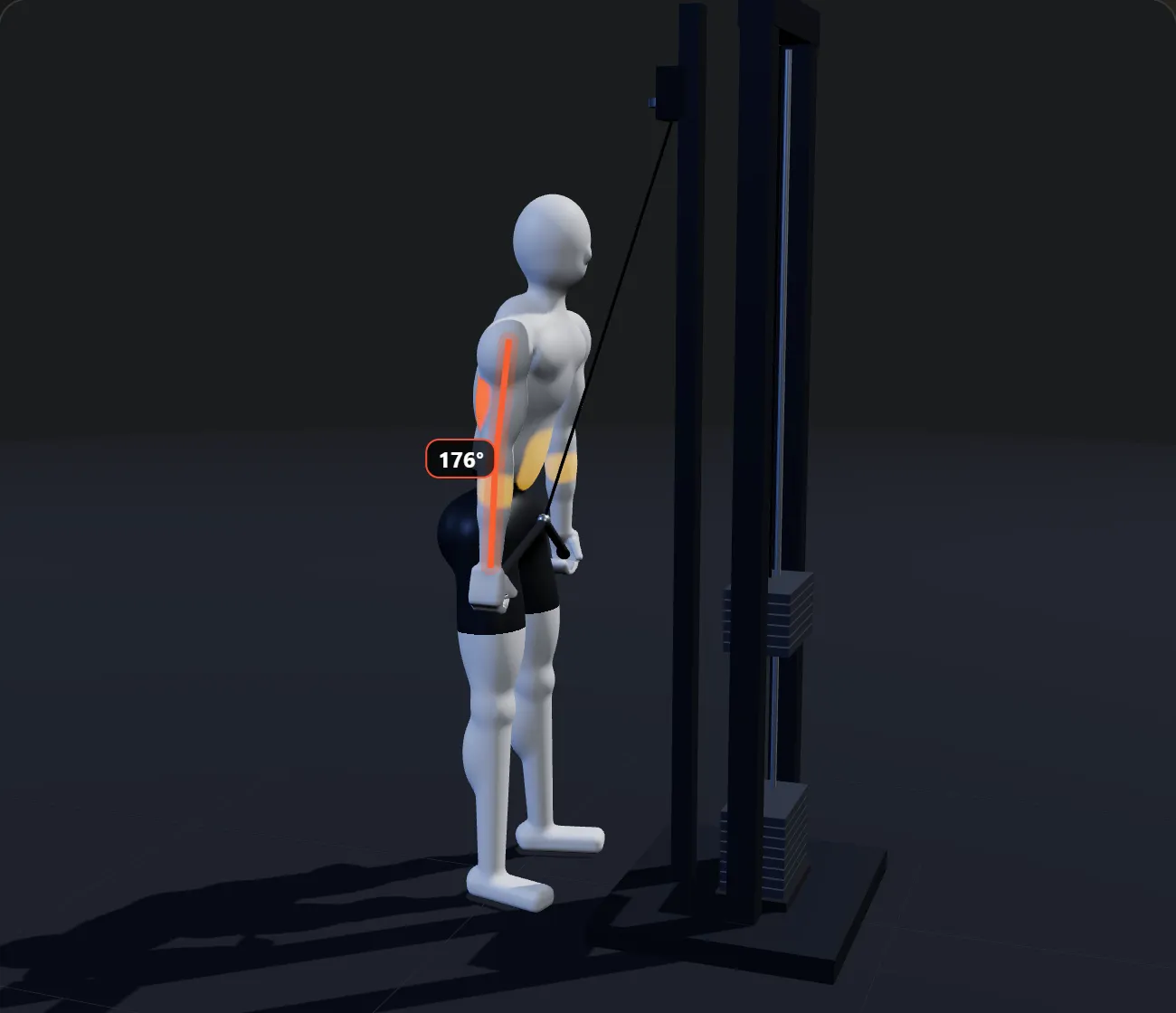
Press the rope down, keeping your elbows at your sides
Loading 3D viewer…
How to do it
- Attach a rope to a high cable pulley and stand facing the machine, feet about hip-width apart.
- Grab the rope ends with your palms facing each other and lean forward slightly from the hips.
- Pin your elbows to your sides with your forearms just above parallel to the floor.
- Press the rope down until your arms are fully straight, pulling the ends apart at the bottom.
- Let the rope rise under control until your forearms pass parallel, without letting your elbows drift up.
Common mistakes
- Elbows flaring out or drifting forward, which brings the shoulders and chest into it.
- Leaning over the rope and using body weight to push it down.
- Letting the weight yank your hands up at the top instead of controlling it.
- Stopping short of a full lockout at the bottom.
Sets and reps
| Goal | Sets | Reps | Rest |
|---|---|---|---|
| Starting out | 2–3 | 10–12 | 60 s |
| Muscle size | 3–4 | 10–15 | 60–90 s |
| Endurance | 2–3 | 15–20 | 30–60 s |
Keep your upper arms against your sides so only your elbows move. If your shoulders roll forward or you lean over the bar to finish a rep, lower the weight. Pause briefly with your arms straight at the bottom.
These are starting points for healthy adults. End each set with a little left in the tank, and move up once you reach the top of a range. The research behind them: How Many Sets and Reps? and How Long to Rest Between Sets.
Variations
- Rope pushdown: A rope lets you spread your hands apart at the bottom of each rep.
- Overhead cable extension: Facing away from the stack with the rope behind your head, which works the triceps' long head in a stretched position.
- Dumbbell triceps kickback: The free-weight option, bent over and working one arm at a time.
The animation shows general technique, not advice for your body. If you have an injury or are new to lifting, check your form with a qualified coach. See the Disclaimer.
Plan your training
- Progressive Overload: The Science of Getting Stronger →
How muscles adapt, heavy versus light loads, and how fast to add weight.
- Sore Muscles After a Workout: The Science of DOMS →
Why muscles ache a day or two after training, and what actually helps.
- Protein Intake Calculator →
Find how much protein you need a day to recover from training and build muscle.
Related exercises
Push-Up
The classic bodyweight chest exercise. Holding your body in one straight line, you lower your chest toward the floor and push back up.
View in 3D →Parallel Bar Dip
A bodyweight push for the chest and triceps. Supported on two bars, you lower your body by bending your elbows, then press back up to straight arms.
View in 3D →Barbell Overhead Press
The standing strength test for the shoulders. You press a barbell from the front of your shoulders to straight arms overhead, moving your head out of the way as it passes.
View in 3D →