Pull-Up
The classic bodyweight back exercise. Hanging from a bar with an overhand grip, you pull your chin up over the bar and lower yourself back down.
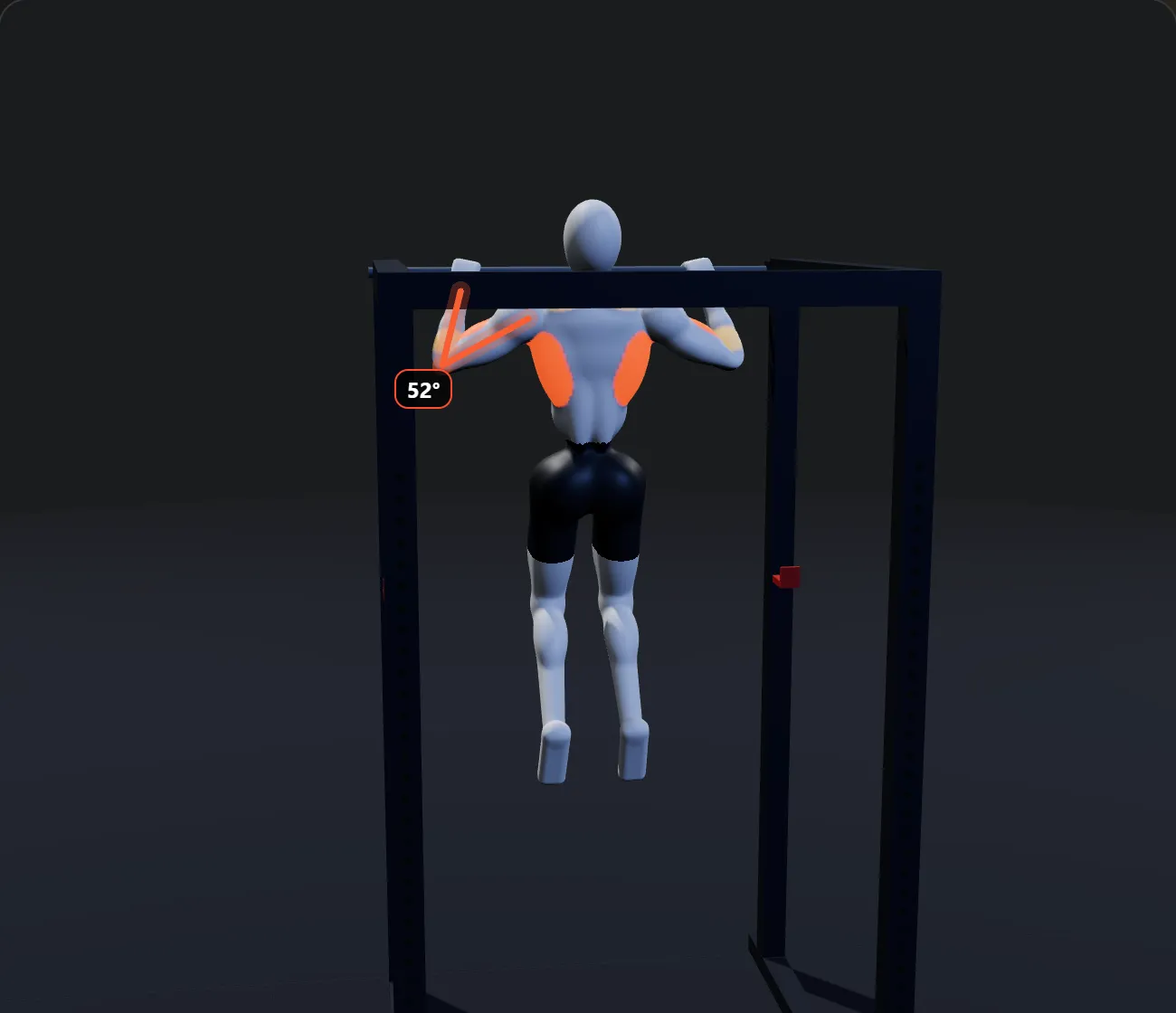
From a dead hang, pull your elbows down to your ribs
Loading 3D viewer…
How to do it
- Grab the bar with an overhand grip, hands a little wider than your shoulders.
- Hang with your arms straight, then pull your shoulder blades down and back to engage your back.
- Pull yourself up by driving your elbows down toward your ribs.
- Keep going until your chin clears the bar, with your chest lifted toward it.
- Lower yourself under control until your arms are straight again.
Common mistakes
- Kicking or swinging your legs to get momentum.
- Cutting the rep short at the bottom instead of reaching straight arms.
- Craning your neck to get your chin over the bar rather than pulling higher.
- Shrugging your shoulders up toward your ears as you pull.
Sets and reps
| Goal | Sets | Reps | Rest |
|---|---|---|---|
| Starting out | 3–5 | 1–5 | 2 min |
| Strength | 3–5 | 3–6 | 2–3 min |
| Muscle size | 3–4 | 6–12 | 1–2 min |
If you can't do one yet, use an assisted machine or a band, or practise negatives: jump to the top and lower yourself over 3–5 seconds. Several short sets of good reps beat one long set of half-reps. Once you can do about 12, add weight with a dip belt.
These are starting points for healthy adults. End each set with a little left in the tank, and move up once you reach the top of a range. The research behind them: How Many Sets and Reps? and How Long to Rest Between Sets.
Variations
- Chin-up: Palms facing you, hands about shoulder-width apart. Usually a little easier, with more work for the biceps.
- Assisted pull-up: A machine, or a band under your knees or feet, takes part of your body weight.
- Negative pull-up: Start at the top and lower yourself slowly. Builds strength for the full rep.
- Lat pulldown: The machine version, where you can set the weight below your body weight.
- Inverted row: A horizontal pull with your feet on the floor; an easier first step.
The animation shows general technique, not advice for your body. If you have an injury or are new to lifting, check your form with a qualified coach. See the Disclaimer.
Plan your training
- Progressive Overload: The Science of Getting Stronger →
How muscles adapt, heavy versus light loads, and how fast to add weight.
- Sore Muscles After a Workout: The Science of DOMS →
Why muscles ache a day or two after training, and what actually helps.
- Protein Intake Calculator →
Find how much protein you need a day to recover from training and build muscle.
Related exercises
Inverted Row
A bodyweight row under a bar set at about waist height. Holding your body straight like a plank, you pull your chest up to the bar.
View in 3D →Seated Cable Row
A seated cable pull for the middle of the back. With your feet braced and torso tall, you row a close-grip handle to your stomach.
View in 3D →One-Arm Dumbbell Row
A single-arm back exercise braced on a bench. With your torso flat, you row a dumbbell from arm's length up beside your waist.
View in 3D →