Cable Crossover
A cable chest fly. Standing between two high pulleys, you sweep the handles down and together in front of your hips in a wide hugging arc.
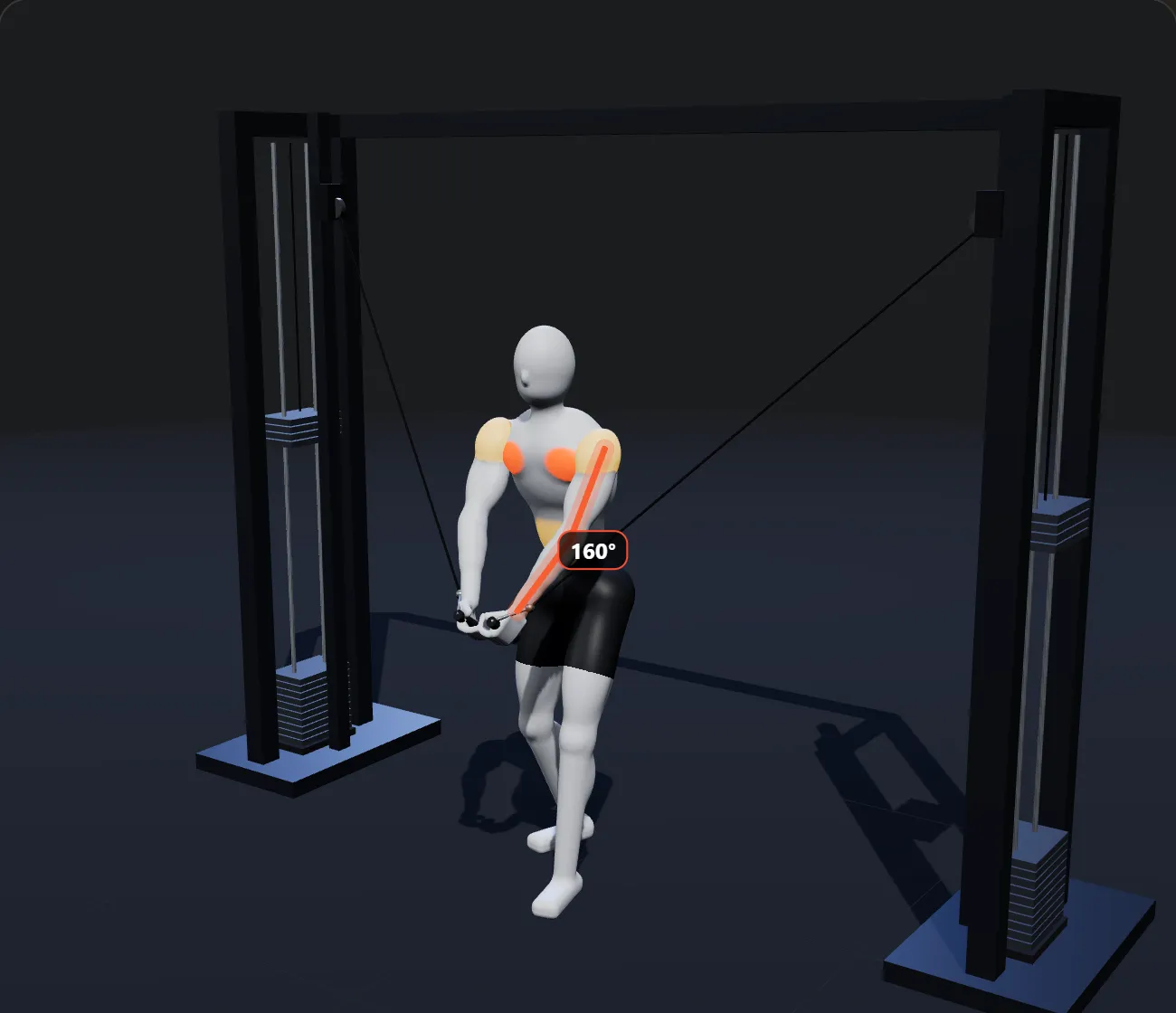
Sweep the handles down and together in a wide arc
Loading 3D viewer…
How to do it
- Set both pulleys to the top and attach a D-handle to each. Grab one in each hand.
- Step forward into a split stance, lean forward slightly from the hips and brace your core.
- Start with your arms out to the sides at about shoulder height, elbows slightly bent and chest up.
- Keeping that elbow bend, sweep your hands down and together in a wide arc until they meet in front of your hips.
- Squeeze your chest, then let your arms open back up slowly until you feel a stretch across your chest.
Common mistakes
- Bending and straightening the elbows so the move becomes a press.
- Leaning far forward and using your body weight to pull the handles down.
- Letting the handles yank your arms back too far behind your body at the start.
- Rounding your shoulders forward at the finish instead of keeping your chest up.
Sets and reps
| Goal | Sets | Reps | Rest |
|---|---|---|---|
| Starting out | 2–3 | 10–12 | 60–90 s |
| Muscle size | 3–4 | 10–15 | 60–90 s |
| Endurance | 2–3 | 15–20 | 30–60 s |
Cables let you change the angle: pulleys set high bring your hands down and in, working more of the lower chest, and pulleys set low bring them up and in for the upper chest. Pick a weight you can control back to the start; letting the stack yank your arms back pulls the shoulders forward.
These are starting points for healthy adults. End each set with a little left in the tank, and move up once you reach the top of a range. The research behind them: How Many Sets and Reps? and How Long to Rest Between Sets.
Variations
- Low-to-high cable fly: Pulleys at the bottom, with your hands sweeping up to chest height. More work for the upper chest.
- Single-arm cable fly: One arm at a time, standing side-on, so you can focus on each side and resist twisting.
- Dumbbell fly: The free-weight version on a bench, hardest at the bottom of the rep.
The animation shows general technique, not advice for your body. If you have an injury or are new to lifting, check your form with a qualified coach. See the Disclaimer.
Plan your training
- Progressive Overload: The Science of Getting Stronger →
How muscles adapt, heavy versus light loads, and how fast to add weight.
- Sore Muscles After a Workout: The Science of DOMS →
Why muscles ache a day or two after training, and what actually helps.
- Protein Intake Calculator →
Find how much protein you need a day to recover from training and build muscle.
Related exercises
Push-Up
The classic bodyweight chest exercise. Holding your body in one straight line, you lower your chest toward the floor and push back up.
View in 3D →Parallel Bar Dip
A bodyweight push for the chest and triceps. Supported on two bars, you lower your body by bending your elbows, then press back up to straight arms.
View in 3D →Barbell Bench Press
The classic chest builder. Lying on a flat bench, you lower a barbell to your lower chest with your elbows tucked, then press it back up over your shoulders.
View in 3D →