Protein, Carbs, and Fat: The Science of Macronutrients
What each macronutrient does, where calorie counts came from, how much protein you really need, and what large trials say about low-fat versus low-carb diets.
7 min read · Published September 18, 2026
At a glance
- Protein, carbohydrate, and fat supply almost all the calories in food: about 4 kcal per gram for protein and carbohydrate and 9 for fat, values worked out more than a century ago.
- For fat loss, large trials find that low-fat and low-carb diets work about equally well. Total calories and whether you can stick with the diet matter more than the exact split.
- Protein is the macro most worth getting right if you train. Muscle gains from strength training level off at around 1.6 g of protein per kg of body weight a day, and more protein helps protect muscle while dieting.
- Quality matters as much as quantity: more fiber and less saturated fat are linked to better long-term health, whatever split you choose.
Every food label lists three numbers under the calories: protein, carbohydrate, and fat. These are the macronutrients — the nutrients you eat in large amounts, and the ones that supply almost all of your energy. Counting “macros” has become popular with athletes and dieters alike. Here’s where the idea comes from, what each macro does, and what the research says about how to split them.
A brief history: measuring the energy in food
The calorie began as a unit of heat in 19th-century physics, not nutrition. It entered everyday food advice mainly through the American chemist Wilbur Olin Atwater, whose 1887 magazine article on food energy and 1894 government bulletin introduced the capitalized “Calorie” — one kilocalorie — that still appears on US food labels[1].
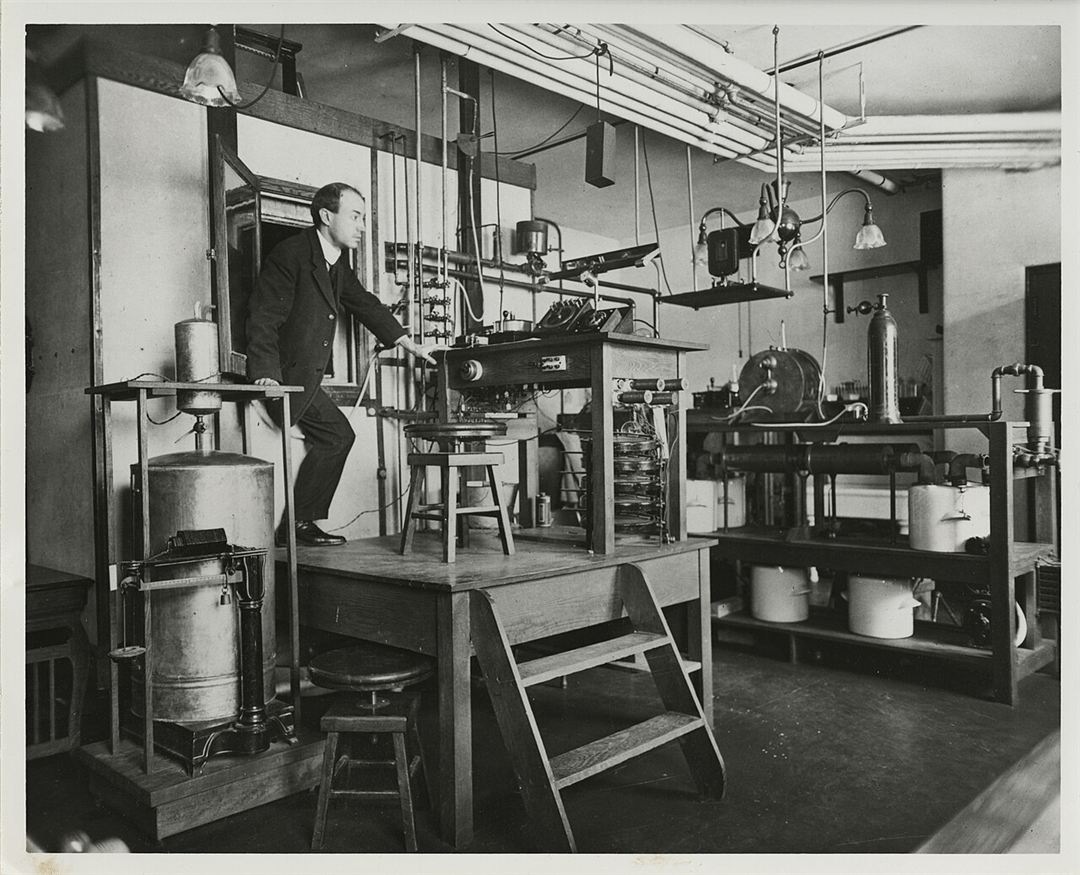
Atwater wanted to measure food energy precisely. At Wesleyan University in Connecticut, he and the physicist Edward Rosa built a room-sized respiration calorimeter: a sealed chamber where a person could live for days while researchers measured everything they ate, the heat their body gave off, and the gases they breathed out. Their experiments, published by the US Department of Agriculture in 1899, showed that the law of conservation of energy applies to the human body just as it does to machines[2]. Food energy in equals heat and work out, plus any energy stored.
From this work came the Atwater factors still used today: about 4 kcal per gram of protein, 4 kcal per gram of carbohydrate, and 9 kcal per gram of fat (and 7 per gram of alcohol). They’re averages that allow for the fact that you don’t digest food completely, and they’re the basis of every calorie count you’ll see.
What each macronutrient does
Protein provides the amino acids your body uses to build and repair muscle, make enzymes and hormones, and maintain skin, bone, and organs. It can be burned for energy, but that isn’t its main job.
Carbohydrates — sugars, starches, and fiber — are the body’s preferred fuel for hard exercise and the brain’s main fuel. You store a limited amount as glycogen in your muscles and liver. Fiber is a carbohydrate you can’t fully digest, and it matters for gut health and much more, as you’ll see below.
Fat is the most concentrated energy source and your main fuel at rest and during easy exercise. It also supplies essential fatty acids your body can’t make, forms part of every cell membrane, and is needed to absorb vitamins A, D, E, and K.
How much of each? The official ranges
In the United States and Canada, the National Academies set broad healthy ranges for adults, known as the Acceptable Macronutrient Distribution Ranges: 10–35% of calories from protein, 45–65% from carbohydrate, and 20–35% from fat. The same report sets the Recommended Dietary Allowance for protein at 0.8 g per kg of body weight per day[3]. That figure is designed to meet the needs of nearly all healthy adults. It’s a minimum for avoiding deficiency, not necessarily the best intake for someone who trains hard or is losing weight.
These ranges are deliberately wide. They reflect the fact that people stay healthy on very different diets, from traditional high-carbohydrate diets in parts of Asia to diets much higher in fat. Within them, the right balance for you depends on your activity, your goals, and the foods you enjoy.
Protein: the macro most worth getting right
Protein has some unusual properties. Gram for gram, it tends to be more filling than carbohydrate or fat, and your body uses more energy digesting and processing it. During weight loss, getting enough protein helps preserve fat-free mass, including muscle[4].
For people who lift weights, a large 2018 meta-analysis pooled 49 trials with 1,863 participants. Protein supplements modestly increased gains in strength and muscle mass during resistance training. But the benefit for muscle mass leveled off at a total protein intake of about 1.6 g per kg of body weight per day[5]. Eating well beyond that didn’t produce further muscle gains on average.
Needs appear to rise when you combine hard training with a calorie deficit. In a 2016 trial, young men ate 40% fewer calories than they needed while doing intense resistance and interval training six days a week for four weeks. Those eating 2.4 g of protein per kg gained about 1.2 kg of lean mass and lost 4.8 kg of fat. Those eating 1.2 g per kg gained almost no lean mass and lost 3.5 kg of fat[6]. That’s an extreme program, but it shows why many sports nutritionists suggest more protein during a diet, not less. Our article on progressive overload covers the training side of building and keeping muscle.
Carbohydrates: fuel for hard work
Carbohydrate is the fuel your muscles rely on most at high intensity, so it matters most for athletes and anyone doing long or hard sessions. Sports nutrition guidelines scale carbohydrate to the demands of training. During events lasting longer than a couple of hours, taking in 30–60 g an hour — and up to 90 g for events over two and a half hours — can improve performance[7]. For someone doing a moderate amount of exercise, everyday needs are much lower.
The type of carbohydrate matters for health. A major 2019 series of reviews in The Lancet, funded in part by the World Health Organization, combined data from 185 long-term observational studies and 58 clinical trials. People who ate the most fiber had a 15–30% lower risk of death from any cause and from heart disease, as well as lower rates of stroke, type 2 diabetes, and colorectal cancer, than those who ate the least. The biggest benefits appeared at 25–29 g of fiber a day, and whole grains showed similar benefits[8]. Many people eat far less fiber than that.
Fat: essential, but the type matters
Fat has been both demonized and celebrated over the past 50 years. The evidence points to a middle path focused on the type of fat. A 2020 Cochrane review of 15 randomized trials with more than 56,000 participants found that cutting saturated fat for at least two years reduced combined cardiovascular events such as heart attacks and strokes by 17%. It had little or no effect on overall mortality. Replacing saturated fat with polyunsaturated fat, found in foods like nuts, seeds, oily fish, and many vegetable oils, or with carbohydrate appeared to be useful strategies[9].
Low-fat or low-carb for weight loss?
This is one of the most studied questions in nutrition, and the answer is surprisingly consistent. In a two-year trial published in the New England Journal of Medicine, 811 overweight adults were assigned to one of four diets with very different proportions of fat, protein, and carbohydrate. After two years, weight loss was similar on all of them — about 3–4 kg on average — and people began regaining weight after the first year whatever their diet[10].
The DIETFITS trial at Stanford tested a healthy low-fat diet against a healthy low-carbohydrate diet in 609 adults for a year. The low-fat group lost 5.3 kg and the low-carb group 6.0 kg, a difference that wasn’t statistically significant. Neither genetic markers nor insulin levels predicted who would do better on which diet[11]. The takeaway: when calories are reduced and food quality is good, the macro split matters much less than whether you can stick with it. The reasons weight loss slows down over time are explained in our article on weight loss and metabolism.
How tracking macros can benefit you
- Enough protein to support your training. Turning a percentage into grams shows at a glance whether you’re near the roughly 1.6 g per kg that research links to the best muscle gains.
- Protecting muscle while dieting. Keeping protein up when calories go down helps you lose fat rather than muscle.
- Fueling performance. Endurance athletes can check that they’re eating enough carbohydrate for their training load.
- Learning what’s in your food. Even a few weeks of tracking teaches you where your protein, carbs, and fats actually come from, which makes good choices easier later without counting.
Putting it into practice
Start with a calorie target from the TDEE Calculator, then use the Macro Calculator to split it into grams of protein, carbs, and fat. If you strength train, check that your protein comes out at roughly 1.6 g per kg of body weight or more, and adjust the split if it doesn’t. Then focus on quality: plenty of fiber from vegetables, fruit, legumes, and whole grains, and mostly unsaturated fats.
Treat the numbers as a guide, not a rulebook. Weigh yourself regularly or track your measurements for a few weeks, and adjust from what actually happens. Our article on measuring body fat explains why the scale doesn’t tell the whole story. If you have diabetes, kidney disease, or another medical condition, or you’re pregnant, talk to a doctor or registered dietitian before making big changes to your diet.
Try it yourself
Put the science into practice with these free tools — no sign-up, right in your browser.
References
- Hargrove, J. L. (2006). History of the calorie in nutrition. The Journal of Nutrition, 136(12), 2957–2961. doi:10.1093/jn/136.12.2957
- Atwater, W. O., & Rosa, E. B. (1899). Description of a new respiration calorimeter and experiments on the conservation of energy in the human body (U.S. Department of Agriculture, Office of Experiment Stations Bulletin No. 63). Government Printing Office. Link
- Institute of Medicine. (2005). Dietary reference intakes for energy, carbohydrate, fiber, fat, fatty acids, cholesterol, protein, and amino acids. The National Academies Press. doi:10.17226/10490
- Westerterp-Plantenga, M. S., Nieuwenhuizen, A., Tomé, D., Soenen, S., & Westerterp, K. R. (2009). Dietary protein, weight loss, and weight maintenance. Annual Review of Nutrition, 29, 21–41. doi:10.1146/annurev-nutr-080508-141056
- Morton, R. W., Murphy, K. T., McKellar, S. R., Schoenfeld, B. J., Henselmans, M., Helms, E., Aragon, A. A., Devries, M. C., Banfield, L., Krieger, J. W., & Phillips, S. M. (2018). A systematic review, meta-analysis and meta-regression of the effect of protein supplementation on resistance training-induced gains in muscle mass and strength in healthy adults. British Journal of Sports Medicine, 52(6), 376–384. doi:10.1136/bjsports-2017-097608
- Longland, T. M., Oikawa, S. Y., Mitchell, C. J., Devries, M. C., & Phillips, S. M. (2016). Higher compared with lower dietary protein during an energy deficit combined with intense exercise promotes greater lean mass gain and fat mass loss: A randomized trial. The American Journal of Clinical Nutrition, 103(3), 738–746. doi:10.3945/ajcn.115.119339
- Burke, L. M., Hawley, J. A., Wong, S. H. S., & Jeukendrup, A. E. (2011). Carbohydrates for training and competition. Journal of Sports Sciences, 29(Suppl. 1), S17–S27. doi:10.1080/02640414.2011.585473
- Reynolds, A., Mann, J., Cummings, J., Winter, N., Mete, E., & Te Morenga, L. (2019). Carbohydrate quality and human health: A series of systematic reviews and meta-analyses. The Lancet, 393(10170), 434–445. doi:10.1016/S0140-6736(18)31809-9
- Hooper, L., Martin, N., Jimoh, O. F., Kirk, C., Foster, E., & Abdelhamid, A. S. (2020). Reduction in saturated fat intake for cardiovascular disease. Cochrane Database of Systematic Reviews, 2020(8), CD011737. doi:10.1002/14651858.CD011737.pub3
- Sacks, F. M., Bray, G. A., Carey, V. J., Smith, S. R., Ryan, D. H., Anton, S. D., McManus, K., Champagne, C. M., Bishop, L. M., Laranjo, N., Leboff, M. S., Rood, J. C., de Jonge, L., Greenway, F. L., Loria, C. M., Obarzanek, E., & Williamson, D. A. (2009). Comparison of weight-loss diets with different compositions of fat, protein, and carbohydrates. The New England Journal of Medicine, 360(9), 859–873. doi:10.1056/NEJMoa0804748
- Gardner, C. D., Trepanowski, J. F., Del Gobbo, L. C., Hauser, M. E., Rigdon, J., Ioannidis, J. P. A., Desai, M., & King, A. C. (2018). Effect of low-fat vs low-carbohydrate diet on 12-month weight loss in overweight adults and the association with genotype pattern or insulin secretion: The DIETFITS randomized clinical trial. JAMA, 319(7), 667–679. doi:10.1001/jama.2018.0245
This article is for general education and isn’t medical advice. The exercises and calculators on this site are general wellness tools, not diagnostic tests or treatments — see the Disclaimer for details. Spotted an error or a newer study we should know about? Let us know.
More articles
- Nutrition · 7 min readWhy Weight Loss Slows Down: The 3,500-Calorie Rule and Your Metabolism
- Reflexes · 7 min readThe Science of Reaction Time: Why Milliseconds Matter
- Eye training · 6 min readSmooth Pursuit: How Your Eyes Follow a Moving Target
- Eye training · 7 min readPeripheral Vision and Visual Attention: Seeing More Than You Look At
- Focus · 7 min readThe Schulte Table: The Science of Visual Search and Focus
- Memory · 6 min readWorking Memory: How Much Can Your Mind Hold at Once?
- Math · 6 min readMental Math: What Happens in Your Brain When You Calculate
- Breathing · 7 min readBox Breathing and 4-7-8 Breathing: The Science of Slow Breathing
- Training · 9 min readHeart Rate Training: The Science of Zones and the Karvonen Formula
- Training · 7 min readPacing Strategy: The Science of Running Your Best Race
- Body composition · 7 min readMeasuring Body Fat: What the Tape, the Scale, and the Scanner Tell You
- Training · 7 min readProgressive Overload: The Science of Getting Stronger