The Schulte Table: The Science of Visual Search and Focus
Where the Schulte table came from, what visual search science says about finding numbers in a grid, how it relates to clinical attention tests, and an honest look at its link to speed reading.
7 min read · Published September 17, 2026
At a glance
- A Schulte table is a grid of shuffled numbers that you find in order. It’s named after the German psychiatrist Walter Schulte and has long been used to assess attention.
- Finding each number is a visual search task. Digits don’t “pop out” from each other, so your brain has to check candidates with help from your peripheral vision.
- Your times reflect processing speed, scanning strategy, and how steadily you stay focused. Clinical tests like the Trail Making Test measure similar abilities.
- It’s a good focus and scanning drill, but reading research doesn’t support claims that it will dramatically increase your reading speed.
It looks almost too simple: a square grid with the numbers 1 to 25 scattered at random. Your job is to find them in order as fast as you can. Yet this humble puzzle, the Schulte table, has been used for decades by psychologists to study attention, by teachers to train concentration, and by speed-reading courses as a warm-up. Here’s what’s going on in your brain when you do one, and what it can and can’t do for you.
What a Schulte table is
The classic version is a 5×5 grid containing the numbers 1–25 in random positions. You point to or tap each number in ascending order while being timed. There are many variations: smaller grids for beginners, larger 6×6 or 7×7 grids, tables with letters instead of numbers, and a two-color version in which you alternate between counting up through black numbers and down through red ones. That last variant, associated with the Soviet psychologist Fyodor Gorbov, who worked on selecting pilots and cosmonauts, adds the challenge of switching attention between two tasks.
A brief history
The tables are traditionally credited to Walter Schulte (1910–1972), a German psychiatrist and psychotherapist, and were originally used as a diagnostic tool for studying attention. They became especially widespread in Soviet and Russian psychology. In the traditional clinical procedure, a person completes five tables in a row. Comparing the times shows more than overall speed. It shows how quickly someone settles into the task, whether their pace stays steady, and whether they start to tire toward the end.
Western psychology developed a strikingly similar tool. The Trail Making Test, originally part of a U.S. Army test battery from the 1940s, asks people to draw a line connecting circles numbered 1 to 25 in order (Part A), then to alternate between numbers and letters (Part B). In 1958 neuropsychologist Ralph Reitan showed that it was sensitive to brain damage[1]. It remains one of the most widely used neuropsychological tests in the world, measuring visual scanning, processing speed, and mental flexibility. The two tests evolved separately, but they rest on the same insight: finding numbers in order is a quick window into how well attention is working.
The science of searching
Every step of a Schulte table is a small visual search, the same process you use to find your keys on a cluttered desk or a friend’s face in a crowd. One of the most influential ideas in this field is Anne Treisman’s feature integration theory[2]. Treisman and Gelade found that a target defined by a single simple feature, such as one red item among green ones, “pops out.” You find it almost instantly, no matter how many distractors there are. But when a target differs from its neighbors only by how its features are combined, search time climbs as the number of items goes up, because attention has to be directed to candidates one by one.
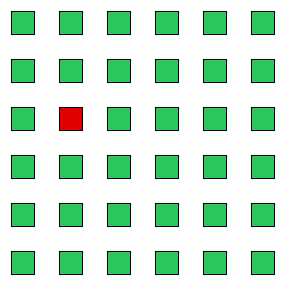
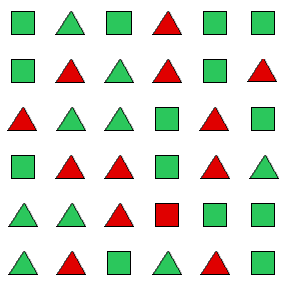
Digits are the hard kind of target. A 3, an 8, and a 6 are built from similar curves, and 12 and 21 contain exactly the same digits. Nothing about “the next number” pops out, so you have to search for it. That’s why grid size matters so much. A 7×7 grid has about twice as many cells as a 5×5, so there are more numbers to find and more places to look for each one, and times climb steeply.
Your eyes don’t check every cell one at a time, though. Each fixation takes in a small region around it. The main limit on how much you can identify there isn’t just blurriness but crowding: in peripheral vision, symbols packed closely together interfere with each other. In 1970 the Dutch researcher Herman Bouma showed that a letter in the periphery becomes hard to identify when neighbors fall within roughly half its distance from the center of gaze[3]. A Schulte grid is dense by design, so identifying numbers away from your gaze is genuinely demanding, and that’s the skill the classic “fix your eyes on the center” advice tries to stretch.
Other abilities join in as well. You hold the current target in working memory, suppress the numbers you’ve already found, and often notice where upcoming numbers are while searching for the current one. Skilled players make heavy use of that last trick.
Schulte tables and speed reading: an honest look
Speed-reading courses often use Schulte tables, claiming they widen your peripheral vision so you can take in a whole line of text at a glance. Reading research tells a more complicated story.
In the 1970s George McConkie and Keith Rayner developed the “moving window” technique, where text outside a small area around a reader’s gaze is scrambled in real time. They found that skilled readers of English pick up useful information from only about 14–15 characters to the right of where they’re looking[4], and later studies showed just 3–4 characters to the left. Clear word identification happens over an even smaller range. This limit comes from the eye’s anatomy and from crowding, not from a lack of training.
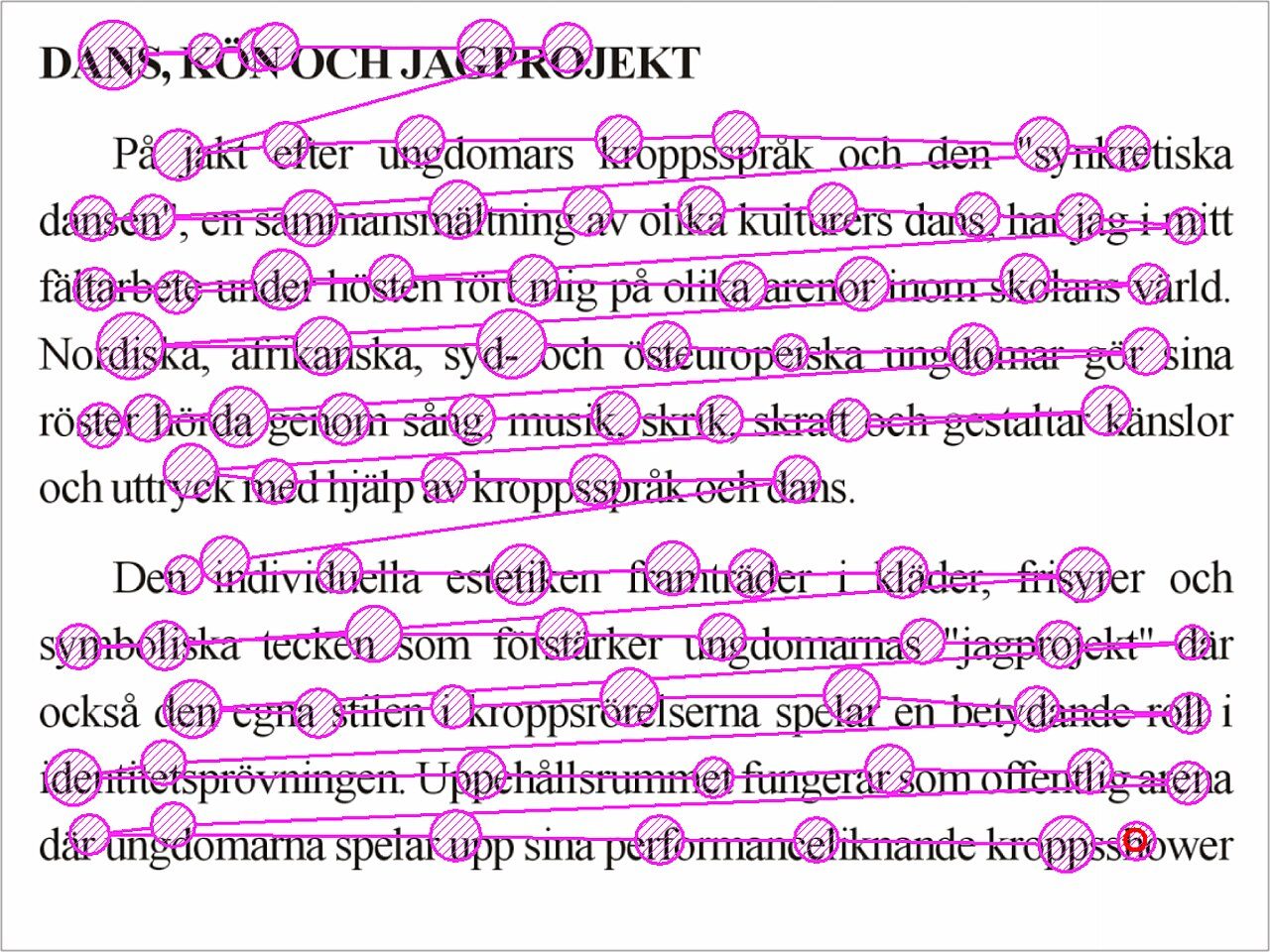
A major 2016 review of speed-reading research concluded that there’s a trade-off between speed and comprehension. Eye movements account for only a small part of reading time, and the real bottleneck is understanding language. The authors found no good evidence that training lets people read many times faster with full comprehension. The most reliable way to read faster is to become a more skilled reader, largely through vocabulary and practice[5]. Skimming is useful for getting the gist, but it comes at the cost of detail.
So a Schulte table can be a good warm-up for attention before reading, and it trains a kind of rapid visual scanning. It isn’t a shortcut to reading a book in an hour.
What practice actually does
If you practice regularly, your times will improve, often a lot in the first sessions. Part of that comes from better strategy (a calmer gaze, less frantic scanning, using what you noticed earlier), part from faster recognition of digits in the grid, and part from simply getting used to the task.
Whether those gains spread to other activities is less certain. A large expert review of brain-training research concluded that practice reliably improves performance on the trained task and on closely similar tasks, while evidence for improvements in distantly related everyday abilities is much weaker[6]. The Schulte table hasn’t been studied as extensively as some other training tasks, so the same cautious expectation applies.
How it can benefit you
- A quick focus check. Like the traditional clinical version, doing a few tables in a row shows whether your concentration holds up or fades. It’s a simple way to see how focused you are on a given day.
- Better scanning habits. Systematic, calm visual search helps with proofreading, reading tables and spreadsheets, checking forms, and finding items on crowded shelves.
- A mental warm-up. A couple of minutes of an absorbing, clearly defined task is a good way to shift into focused work or study.
- A calm kind of concentration. Many people find that the best times come not from rushing but from a relaxed, steady gaze. That’s a useful lesson in itself.
How to practice
Open the Schulte Table and start with the classic 5×5 grid. Rest your gaze near the center and try to spot each number without scanning cell by cell. It will feel slower at first. Turn on Highlight found while you’re learning, then switch it off for the traditional version. For a concentration check in the clinical style, do three to five tables in a row and compare your first and last times. Once 5×5 feels comfortable, move up to 6×6 or 7×7. Short daily sessions work better than long, infrequent ones.
Try it yourself
Put the science into practice with this free exercise — no sign-up, right in your browser.
References
- Reitan, R. M. (1958). Validity of the Trail Making Test as an indicator of organic brain damage. Perceptual and Motor Skills, 8(3), 271–276. doi:10.2466/pms.1958.8.3.271
- Treisman, A. M., & Gelade, G. (1980). A feature-integration theory of attention. Cognitive Psychology, 12(1), 97–136. doi:10.1016/0010-0285(80)90005-5
- Bouma, H. (1970). Interaction effects in parafoveal letter recognition. Nature, 226(5241), 177–178. doi:10.1038/226177a0
- McConkie, G. W., & Rayner, K. (1975). The span of the effective stimulus during a fixation in reading. Perception & Psychophysics, 17(6), 578–586. doi:10.3758/BF03203972
- Rayner, K., Schotter, E. R., Masson, M. E. J., Potter, M. C., & Treiman, R. (2016). So much to read, so little time: How do we read, and can speed reading help? Psychological Science in the Public Interest, 17(1), 4–34. doi:10.1177/1529100615623267
- Simons, D. J., Boot, W. R., Charness, N., Gathercole, S. E., Chabris, C. F., Hambrick, D. Z., & Stine-Morrow, E. A. L. (2016). Do “brain-training” programs work? Psychological Science in the Public Interest, 17(3), 103–186. doi:10.1177/1529100616661983
This article is for general education and isn’t medical advice. The exercises on this site are general wellness tools, not diagnostic tests or treatments — see the Disclaimer for details. Spotted an error or a newer study we should know about? Let us know.
More articles
- Reflexes · 7 min readThe Science of Reaction Time: Why Milliseconds Matter
- Eye training · 6 min readSmooth Pursuit: How Your Eyes Follow a Moving Target
- Eye training · 7 min readPeripheral Vision and Visual Attention: Seeing More Than You Look At
- Memory · 6 min readWorking Memory: How Much Can Your Mind Hold at Once?
- Math · 6 min readMental Math: What Happens in Your Brain When You Calculate
- Breathing · 7 min readBox Breathing and 4-7-8 Breathing: The Science of Slow Breathing