Why Weight Loss Slows Down: The 3,500-Calorie Rule and Your Metabolism
Where the 3,500-calorie rule came from and why it overpromises, how metabolism adapts as you lose weight, whether fast or slow loss is better, and what helps people keep weight off.
7 min read · Published September 18, 2026
At a glance
- The famous “3,500 calories per pound” rule dates from 1958. It’s a fair estimate of the energy stored in body fat, but it overpromises when used to predict weight loss over months.
- As you lose weight, you burn fewer calories — partly because a smaller body needs less energy, and partly because the body actively adapts. The same diet produces a smaller and smaller deficit.
- Weight loss usually starts fast, largely from water stored with carbohydrate, then slows. Plateaus are normal physiology, not failure.
- Losing even 5–10% of your body weight brings real health benefits, and research on people who keep weight off points to steady habits rather than any special diet.
Almost everyone who has tried to lose weight knows the pattern. The first couple of weeks go brilliantly. Then progress slows, even though you’re eating exactly the same way, until the scale seems to stop moving altogether. It’s easy to blame yourself. But this slowdown is predictable, and scientists can explain most of it. Understanding it makes it much easier to set realistic goals and stay on track.
Where the 3,500-calorie rule came from
In 1958 the physician Max Wishnofsky published an estimate of how many calories correspond to a pound of body weight gained or lost. Body fat tissue isn’t pure fat — it also contains water and a little protein — and his calculation came out at about 3,500 kcal per pound, or roughly 7,700 kcal per kilogram[1]. From that came a tidy rule of thumb that still appears in textbooks and on health websites: cut 500 calories a day, and you’ll lose a pound a week.
As an estimate of the energy stored in fat, the number is reasonable. The problem is what happens when it’s used to predict weight loss over weeks and months. The rule assumes that your calorie deficit stays the same for as long as you diet. It doesn’t.
Why the first weeks are the fastest
Early weight loss includes a lot of water. Your body stores carbohydrate as glycogen in the muscles and liver, and each gram of glycogen is stored with about three to four grams of water. When you cut calories, and especially carbohydrate, you use up some of that glycogen and release the water with it[2]. That’s why the scale can drop several pounds in the first week or two, and why weight can jump back quickly after a high-carbohydrate meal. Neither change is mostly fat.
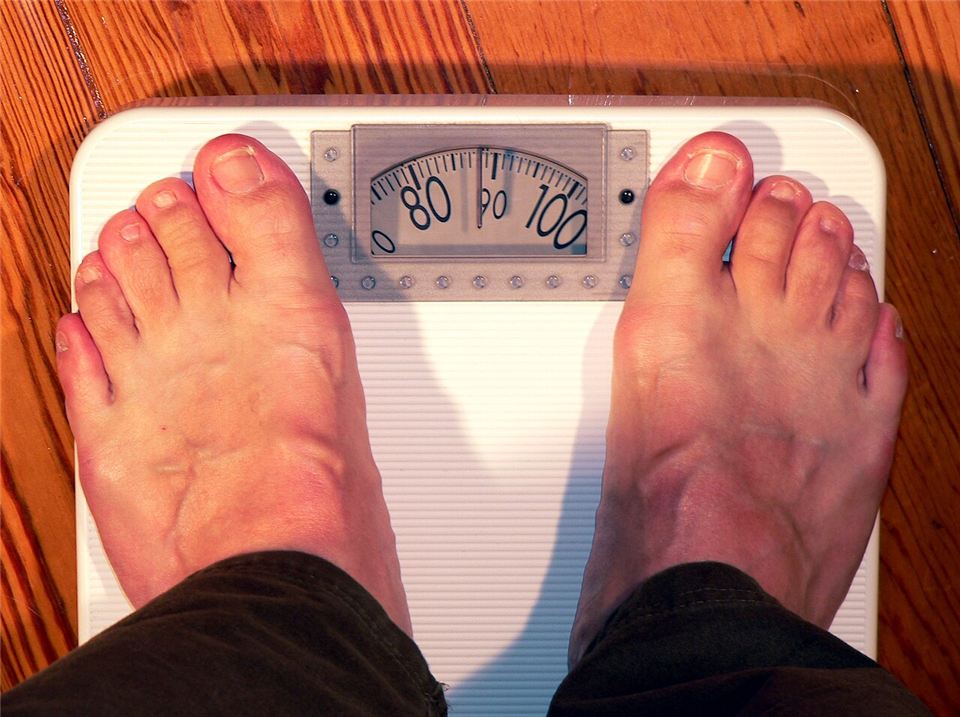
Why weight loss slows down
After the first weeks, two things work against a fixed calorie deficit. First, a smaller body simply needs less energy. It takes fewer calories to keep a lighter body running, and fewer to move it around. Second, the body actively adapts, as described below.
Researchers at the US National Institutes of Health led by Kevin Hall built a mathematical model of human metabolism that accounts for these changes. It showed that body weight responds slowly to a lasting change in calorie intake, with about half of the eventual change happening in roughly the first year. It also showed that people with more body fat lose more weight for the same calorie cut, and take longer to reach their new stable weight[3]. When another team compared the 3,500-calorie rule against actual results from seven tightly controlled weight loss experiments, they found the rule substantially overestimated how much weight people lost[4].
In practice, this means the weight you lose in the first month of a diet won’t repeat every month. If you want to keep losing at the same pace, you have to keep adjusting — or accept that progress will gradually slow.
A brief history: lessons from a wartime experiment
Much of what we know about how the body responds to eating too little comes from an extraordinary study during World War II. At the University of Minnesota, the physiologist Ancel Keys and his colleagues recruited 36 conscientious objectors — young men who had refused military service on moral grounds — to live on a severely restricted diet. The goal was to learn how to safely refeed civilians who had been starved during the war[5].
Most of the volunteers lost more than a quarter of their body weight. Many developed anemia, extreme fatigue, weakness, irritability, apathy, and swelling in their legs[5]. The experiment would never be approved today, but it showed how strongly the body and mind push back against severe energy restriction. When surviving volunteers were interviewed decades later, all said they would do it again. Keys is also known for naming the body mass index, a story told in our article on measuring body fat.
Metabolic adaptation: the body pushes back
Modern experiments have measured this pushback precisely. In a classic study published in the New England Journal of Medicine in 1995, researchers held volunteers at 10% below their usual weight. Their total daily energy use fell by about 6–8 kcal per kilogram of lean body mass, and energy use rose when the same people were held 10% above their usual weight[6]. The researchers concluded that these compensating changes oppose keeping a body weight different from the usual one, and may help explain why weight loss is so hard to maintain.
The most dramatic example comes from contestants on the TV show The Biggest Loser. Fourteen contestants who lost an average of 58 kg during the competition were measured again six years later. They had regained about 41 kg on average, yet their resting metabolism was still about 700 kcal a day below where it started — around 500 kcal a day lower than their new body size would predict[7]. That was an extreme, very rapid weight loss, and most people won’t see changes that large. But it shows that metabolic adaptation is real and can last.
Fast or slow: does the pace matter?
Guidelines usually recommend losing about 0.5–1 kg (1–2 lb) a week, partly because slower weight loss has long been thought easier to keep off. A 2014 randomized trial in The Lancet Diabetes & Endocrinology tested that belief directly. Two hundred adults with obesity were assigned to lose weight either rapidly, over 12 weeks on a very-low-calorie diet, or gradually over 36 weeks. More people in the rapid group reached the weight loss target. But by nearly three years later, both groups had regained about 71% of the weight they lost[8]. The pace of weight loss didn’t change how much came back.
That doesn’t make crash diets a good idea. Very-low-calorie diets are used under medical supervision for good reason — in that trial, one person in the rapid group developed gallbladder inflammation that needed surgery — and eating very little makes it harder to get enough protein and nutrients[8]. Weight loss from dieting also includes some muscle. Eating enough protein and doing exercise, especially resistance training, helps preserve muscle while the fat comes off[9]. See our article on macronutrients and our article on progressive overload for how to do both.
How realistic planning can benefit you
- Goals you can actually hit. Knowing that loss slows over time helps you choose a timeline that won’t leave you discouraged after the first month.
- Less panic at plateaus. Understanding water weight and metabolic adaptation makes a stalled week look like normal physiology, not failure.
- Health benefits sooner than you think. In a study of more than 5,000 adults with type 2 diabetes, people who lost just 5–10% of their weight in a year saw meaningful improvements in blood sugar, blood pressure, and blood fats, and those who lost more saw bigger benefits[10]. You don’t have to reach a “goal weight” to benefit.
- A focus on keeping it off. Planning for maintenance from the start matters, because that’s where most weight loss efforts are won or lost.
What helps people keep weight off
There is good news here. Research suggests about one in five people with overweight manage to lose at least 10% of their weight and keep it off for a year or more. Members of the US National Weight Control Registry, who have lost an average of 33 kg and kept it off for more than five years, report some common habits: about an hour of physical activity a day, a consistent eating pattern through the week and weekends, regular breakfast, and weighing themselves regularly. And maintenance seems to get easier with time — after two to five years, the chances of long-term success rise considerably[11].
Putting it into practice
Use the Weight Loss Timeline Calculator to see how long a goal might take at a given weekly rate, or what rate a target date would need. Because it’s based on the 3,500-calorie rule, treat its date as a best case: the calculator also shows your maintenance calories at your goal weight, which is a reminder that your intake will need to come down, or your activity go up, as you get lighter. Recalculate every few weeks with your new weight.
Watch the weekly trend rather than daily readings, and pair the scale with a tape measure — our article on measuring body fat explains why. And if you have a medical condition, take medication, or plan to eat very little, talk to a doctor or registered dietitian first.
Try it yourself
Put the science into practice with these free tools — no sign-up, right in your browser.
References
- Wishnofsky, M. (1958). Caloric equivalents of gained or lost weight. The American Journal of Clinical Nutrition, 6(5), 542–546. doi:10.1093/ajcn/6.5.542
- Kreitzman, S. N., Coxon, A. Y., & Szaz, K. F. (1992). Glycogen storage: Illusions of easy weight loss, excessive weight regain, and distortions in estimates of body composition. The American Journal of Clinical Nutrition, 56(1 Suppl.), 292S–293S. doi:10.1093/ajcn/56.1.292S
- Hall, K. D., Sacks, G., Chandramohan, D., Chow, C. C., Wang, Y. C., Gortmaker, S. L., & Swinburn, B. A. (2011). Quantification of the effect of energy imbalance on bodyweight. The Lancet, 378(9793), 826–837. doi:10.1016/S0140-6736(11)60812-X
- Thomas, D. M., Martin, C. K., Lettieri, S., Bredlau, C., Kaiser, K., Church, T., Bouchard, C., & Heymsfield, S. B. (2013). Can a weight loss of one pound a week be achieved with a 3500-kcal deficit? Commentary on a commonly accepted rule. International Journal of Obesity, 37(12), 1611–1613. doi:10.1038/ijo.2013.51
- Kalm, L. M., & Semba, R. D. (2005). They starved so that others be better fed: Remembering Ancel Keys and the Minnesota experiment. The Journal of Nutrition, 135(6), 1347–1352. doi:10.1093/jn/135.6.1347
- Leibel, R. L., Rosenbaum, M., & Hirsch, J. (1995). Changes in energy expenditure resulting from altered body weight. The New England Journal of Medicine, 332(10), 621–628. doi:10.1056/NEJM199503093321001
- Fothergill, E., Guo, J., Howard, L., Kerns, J. C., Knuth, N. D., Brychta, R., Chen, K. Y., Skarulis, M. C., Walter, M., Walter, P. J., & Hall, K. D. (2016). Persistent metabolic adaptation 6 years after “The Biggest Loser” competition. Obesity, 24(8), 1612–1619. doi:10.1002/oby.21538
- Purcell, K., Sumithran, P., Prendergast, L. A., Bouniu, C. J., Delbridge, E., & Proietto, J. (2014). The effect of rate of weight loss on long-term weight management: A randomised controlled trial. The Lancet Diabetes & Endocrinology, 2(12), 954–962. doi:10.1016/S2213-8587(14)70200-1
- Cava, E., Yeat, N. C., & Mittendorfer, B. (2017). Preserving healthy muscle during weight loss. Advances in Nutrition, 8(3), 511–519. doi:10.3945/an.116.014506
- Wing, R. R., Lang, W., Wadden, T. A., Safford, M., Knowler, W. C., Bertoni, A. G., Hill, J. O., Brancati, F. L., Peters, A., Wagenknecht, L., & the Look AHEAD Research Group. (2011). Benefits of modest weight loss in improving cardiovascular risk factors in overweight and obese individuals with type 2 diabetes. Diabetes Care, 34(7), 1481–1486. doi:10.2337/dc10-2415
- Wing, R. R., & Phelan, S. (2005). Long-term weight loss maintenance. The American Journal of Clinical Nutrition, 82(1 Suppl.), 222S–225S. doi:10.1093/ajcn/82.1.222S
This article is for general education and isn’t medical advice. The exercises and calculators on this site are general wellness tools, not diagnostic tests or treatments — see the Disclaimer for details. Spotted an error or a newer study we should know about? Let us know.
More articles
- Nutrition · 7 min readProtein, Carbs, and Fat: The Science of Macronutrients
- Reflexes · 7 min readThe Science of Reaction Time: Why Milliseconds Matter
- Eye training · 6 min readSmooth Pursuit: How Your Eyes Follow a Moving Target
- Eye training · 7 min readPeripheral Vision and Visual Attention: Seeing More Than You Look At
- Focus · 7 min readThe Schulte Table: The Science of Visual Search and Focus
- Memory · 6 min readWorking Memory: How Much Can Your Mind Hold at Once?
- Math · 6 min readMental Math: What Happens in Your Brain When You Calculate
- Breathing · 7 min readBox Breathing and 4-7-8 Breathing: The Science of Slow Breathing
- Training · 9 min readHeart Rate Training: The Science of Zones and the Karvonen Formula
- Training · 7 min readPacing Strategy: The Science of Running Your Best Race
- Body composition · 7 min readMeasuring Body Fat: What the Tape, the Scale, and the Scanner Tell You
- Training · 7 min readProgressive Overload: The Science of Getting Stronger