Pacing Strategy: The Science of Running Your Best Race
Why even pacing beats a fast start, what world records reveal about how the best runners spread their effort, how the marathon got its odd distance, and how to plan your own splits.
7 min read · Published September 18, 2026
At a glance
- Pacing is how you spread your effort across a race. For events longer than a couple of minutes, an even pace usually beats a fast start.
- World records at 5,000 m, 10,000 m, and the marathon are run at a remarkably steady pace, often with a finishing kick at the end.
- Most everyday runners do the opposite: in a study of nearly 92,000 marathon results, runners slowed by 12–16% on average in the second half.
- Knowing your target pace and checking your splits is one of the simplest ways to run a faster race without getting any fitter.
Two runners with identical fitness line up for a 10K. One sets off with the crowd, feels great for three kilometers, and then spends the rest of the race hanging on. The other starts a little slower than feels natural, holds a steady rhythm, and passes dozens of people in the last few kilometers. The second runner almost always finishes faster. The difference isn’t fitness. It’s pacing: how you spend your energy over the distance.
What pacing means
Sports scientists describe several basic pacing patterns. In an even pace, speed stays roughly constant. In a positive pace, the athlete starts fast and gradually slows. A negative pace gets faster over the race, and an all-out strategy means going as hard as possible from the start. Some races follow a U-shaped pattern, with a fast start and a fast finish around a steadier middle[1].
Which strategy works best depends on the length of the event. For very short efforts of about 30 seconds or less, going all-out from the gun makes sense. For events lasting longer than about two minutes — which includes every distance from the mile to the marathon — performance tends to improve when effort is spread more evenly[1]. The reason is energy supply. Your fastest energy systems produce power quickly but can’t keep it up, and running above your sustainable pace early builds fatigue that you pay back with interest later.
What world records reveal
If you want to know how to pace a race, study the people who have run it fastest. In a 2006 analysis of men’s world records, researchers looked at kilometer-by-kilometer splits from 32 world records at 5,000 m and 34 at 10,000 m set between the 1920s and 2004. The first and final kilometers were faster than the middle ones, giving an overall even pace with a finishing kick[2]. The 800 m was the exception: in 26 world records, the first lap was faster than the second in all but two.
The marathon tells a similar story, with a twist. When Spanish researchers analyzed every men’s marathon world record over the previous 50 years, they found that record holders from 1967 to 1988 started much faster and then slowed dramatically after 25 km. More recent record holders ran with far smaller changes in speed across the whole race[3]. As the marathon has become faster, it has also become more evenly paced.
Your brain as a pacemaker
That finishing kick is revealing. If the runners were truly exhausted, they couldn’t speed up at the end. One influential explanation is that the brain sets pace in advance. According to this idea, it uses what you know about the distance still to go, along with signals from your muscles, temperature, and fuel levels, to choose an effort that gets you to the finish without a dangerous breakdown — keeping a small reserve that becomes the final sprint[4].
Experiments support parts of this picture. In studies where the air is hotter, oxygen is lower, fuel stores are reduced, or athletes are misled about how far they’ve gone, people change their pace early in the effort, before any single system has failed[4]. Scientists still debate exactly how this regulation works, but the practical message is clear: pacing is a skill your brain learns. Experience teaches it what a sustainable effort feels like.
Why so many runners start too fast
Everyday racers rarely pace like world-record holders. A study of 91,929 performances from 14 US marathons found that men slowed by 15.6% in the second half on average, and women by 11.7%. Men were far more likely to slow dramatically, by 30% or more, and slower finishers tended to slow the most. Runners with more racing experience slowed less[5].
It’s easy to see why. On race day you’re rested, excited, and surrounded by people moving fast. The first kilometers feel effortless, so a pace that’s 10 or 15 seconds per kilometer too quick doesn’t register as a mistake until much later. The cost of that early speed arrives in the second half, when it’s too late to get the energy back.
A brief history: from Marathon to Windsor Castle
The marathon is named after the legend of a Greek messenger who ran from the battlefield of Marathon to Athens around 490 BCE to announce victory over the Persians. The ancient sources disagree about the details — the historian Herodotus describes the runner Pheidippides running from Athens to Sparta to ask for help, while the famous victory run appears in later writers — but the story inspired a race of about 40 km at the first modern Olympics in Athens in 1896.
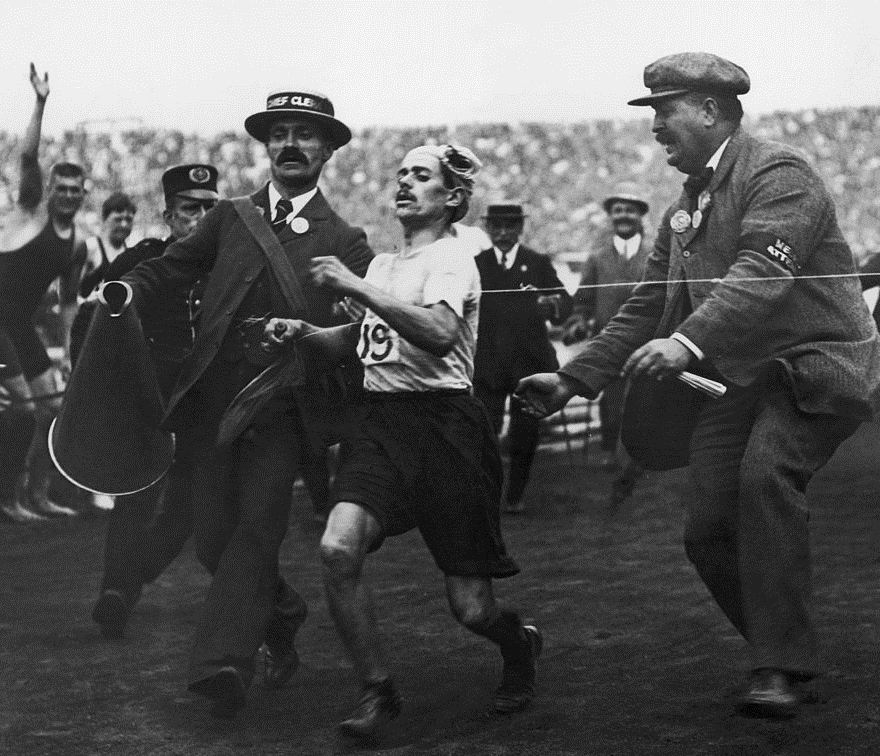
The exact distance came later, and almost by accident. For the 1908 London Olympics, the course was laid out so the royal family could watch the start from Windsor Castle, and it finished in the new Olympic stadium. It measured 26 miles and 385 yards — 42.195 km[6]. That race also produced one of the most famous finishes in sport. Italy’s Dorando Pietri entered the stadium in the lead but collapsed on the track. Officials helped him across the line, and he was disqualified, with the title going to Johnny Hayes of the United States. Queen Alexandra later presented Pietri with a special cup for his effort[6]. The odd distance stuck and became the official marathon distance in the 1920s.
Pacing itself became a strategy in its own right in the 20th century. When Roger Bannister ran the first sub-four-minute mile on 6 May 1954 at Iffley Road in Oxford, finishing in 3:59.4, his teammates Chris Brasher and Chris Chataway took turns leading to keep the pace on target. Paid and planned pacemakers became common in record attempts. The idea reached its extreme in 2019, when Eliud Kipchoge ran a marathon distance in 1:59:40 in Vienna behind rotating teams of pacers. Because of the special pacing setup, the run wasn’t eligible as an official record, but it showed how much a perfectly even effort can be worth.
Predicting your race times
Can a 5K time tell you what you might run for a half marathon? In 1981, the engineer and runner Peter Riegel analyzed world records and found that race time rises a little faster than distance. His formula, T₂ = T₁ × (D₂ ÷ D₁)1.06, predicts a time for a new distance from a known one[7]. Doubling the distance takes about 2.08 times as long, not twice as long.
Predictions like this are useful for setting realistic goals, but they assume you’ve trained for the longer distance. A strong 5K runner who has never run long will usually fall short of the predicted marathon time. Use predictions as a starting estimate and adjust from real races.
Fuel matters for longer races
Pacing and fueling are linked. Your muscles store a limited amount of carbohydrate, and running too fast early burns through it more quickly. For long events, sports nutrition experts recommend taking in carbohydrate during the race: about 30–60 g per hour for events of longer duration, and up to 90 g per hour for events lasting more than two and a half hours, using products that combine different types of carbohydrate[8]. See our article on macronutrients for how carbohydrate fits into your overall diet.
How good pacing can benefit you
- Faster times for free. Avoiding a fast start and a big slowdown can save minutes in a half marathon or marathon without any extra training.
- A more enjoyable race. Even pacing means finishing strong and passing people, instead of struggling through the final third.
- Better training. Knowing your paces helps you run easy runs easy and hit the right speed in workouts, which makes each session do the job it’s meant to do.
- Realistic goals. Working out the pace a goal time requires tells you quickly whether the goal is ambitious or out of reach.
Putting it into practice
Before your next race, use the Running Pace Calculator to turn a goal time into a target pace and a list of split times. Write down a few checkpoints, such as every 5 km, or set your watch to show your average pace. Aim to run the first few kilometers at goal pace or slightly slower, even if it feels too easy — it should. If you feel good after halfway, speed up gradually.
Don’t panic if your watch disagrees with the kilometer markers. Official road courses are measured along the shortest possible route a runner could take[9], but nobody runs every corner perfectly, so GPS watches often record a slightly longer distance by the finish. Pay more attention to the course markers than to your watch late in a race.
Finally, pace isn’t the only way to measure effort. On hilly courses or hot days, a steady effort may mean a slower pace. Our article on heart rate training explains how to use heart rate alongside pace, so that your easy days and race days each get the right effort.
Try it yourself
Put the science into practice with this free tool — no sign-up, right in your browser.
References
- Abbiss, C. R., & Laursen, P. B. (2008). Describing and understanding pacing strategies during athletic competition. Sports Medicine, 38(3), 239–252. doi:10.2165/00007256-200838030-00004
- Tucker, R., Lambert, M. I., & Noakes, T. D. (2006). An analysis of pacing strategies during men’s world-record performances in track athletics. International Journal of Sports Physiology and Performance, 1(3), 233–245. doi:10.1123/ijspp.1.3.233
- Díaz, J. J., Fernández-Ozcorta, E. J., & Santos-Concejero, J. (2018). The influence of pacing strategy on marathon world records. European Journal of Sport Science, 18(6), 781–786. doi:10.1080/17461391.2018.1450899
- Tucker, R., & Noakes, T. D. (2009). The physiological regulation of pacing strategy during exercise: A critical review. British Journal of Sports Medicine, 43(6), e1. doi:10.1136/bjsm.2009.057562
- Deaner, R. O., Carter, R. E., Joyner, M. J., & Hunter, S. K. (2015). Men are more likely than women to slow in the marathon. Medicine & Science in Sports & Exercise, 47(3), 607–616. doi:10.1249/MSS.0000000000000432
- World Athletics. (2008, May 31). Queen Elizabeth marks 1908 London Olympics and centenary of “classic marathon distance”. Link
- Riegel, P. S. (1981). Athletic records and human endurance. American Scientist, 69(3), 285–290. Link
- Burke, L. M., Hawley, J. A., Wong, S. H. S., & Jeukendrup, A. E. (2011). Carbohydrates for training and competition. Journal of Sports Sciences, 29(Suppl. 1), S17–S27. doi:10.1080/02640414.2011.585473
- Association of International Marathons and Distance Races. The measurement of road race courses (2nd ed.). AIMS / World Athletics. Link
This article is for general education and isn’t medical advice. The exercises and calculators on this site are general wellness tools, not diagnostic tests or treatments — see the Disclaimer for details. Spotted an error or a newer study we should know about? Let us know.
More articles
- Training · 9 min readHeart Rate Training: The Science of Zones and the Karvonen Formula
- Training · 7 min readProgressive Overload: The Science of Getting Stronger
- Reflexes · 7 min readThe Science of Reaction Time: Why Milliseconds Matter
- Eye training · 6 min readSmooth Pursuit: How Your Eyes Follow a Moving Target
- Eye training · 7 min readPeripheral Vision and Visual Attention: Seeing More Than You Look At
- Focus · 7 min readThe Schulte Table: The Science of Visual Search and Focus
- Memory · 6 min readWorking Memory: How Much Can Your Mind Hold at Once?
- Math · 6 min readMental Math: What Happens in Your Brain When You Calculate
- Breathing · 7 min readBox Breathing and 4-7-8 Breathing: The Science of Slow Breathing
- Nutrition · 7 min readProtein, Carbs, and Fat: The Science of Macronutrients
- Body composition · 7 min readMeasuring Body Fat: What the Tape, the Scale, and the Scanner Tell You
- Nutrition · 7 min readWhy Weight Loss Slows Down: The 3,500-Calorie Rule and Your Metabolism