Working Memory: How Much Can Your Mind Hold at Once?
The science of short-term and working memory — from Miller’s magical number seven to the Corsi block test — plus what brain-training research really shows and how sequence games can help.
6 min read · Published September 17, 2026
At a glance
- Working memory is the mental workspace that holds information for a few seconds while you use it, and it holds surprisingly little.
- Sequence games like Simon are close relatives of the Corsi block-tapping test, a standard clinical measure of visuospatial memory span.
- Strategies such as grouping steps into shapes or patterns (“chunking”) can greatly increase how much you remember. This is the most reliable way to improve.
- Memory training reliably improves the trained task, but large studies find little evidence that it boosts general intelligence. Treat it as practice, not a brain upgrade.
Someone reads you a phone number and you repeat it under your breath until you can type it in. A colleague gives you three quick instructions and you try to keep them straight while doing the first. You work out a tip in your head. All of these rely on working memory, the small, fast, fragile mental workspace where you hold information while you do something with it.
What working memory is
Psychologists distinguish long-term memory, the vast store of everything you know, from the much smaller system that holds what you’re thinking about right now. Early researchers called this short-term memory and pictured it as a simple holding tank. In 1974 Alan Baddeley and Graham Hitch argued that it’s better understood as an active working memory made of several cooperating parts[1]:
- The phonological loop holds sounds and words, like the phone number you repeat to yourself.
- The visuospatial sketchpad holds images, locations, and paths, like the route to a café or where things are on a grid.
- The central executive directs attention, decides what to focus on, and coordinates the other parts.
In 2000 Baddeley added a fourth part, the episodic buffer, which ties information from different sources into single episodes and links working memory to long-term memory[2]. A sequence game like the Sequence Memory Test leans mainly on the visuospatial sketchpad (which tiles, in what order), but many people also recruit the verbal loop by quietly naming positions, such as “top left, middle, bottom right.”
How much can you hold?
In 1956 George Miller published one of the most famous papers in psychology, “The Magical Number Seven, Plus or Minus Two.” He observed that people can typically repeat back about seven items, such as digits, letters, or words[3]. Later research suggests the true limit is even smaller. When people are prevented from rehearsing or grouping items, capacity drops to around three to five chunks, often summarized as about four[4].
The key word there is chunks. A chunk is a meaningful unit, and what counts as one depends on what you already know. In a classic 1973 study, chess masters glanced at a board from a real game and could reconstruct it far better than beginners, because they saw familiar patterns instead of individual pieces. When the pieces were placed randomly, their advantage largely disappeared[5].
The most dramatic demonstration came in 1980. A university student known as “SF” practiced remembering digit strings for more than 200 hours. A keen runner, he learned to recode groups of digits as running times (“3492” became “3 minutes 49.2 seconds, near a world-record mile”). His digit span grew from about 7 to 79 digits. But when he was tested on letters instead of digits, his span dropped straight back to about six[6]. His working memory hadn’t grown. He had built a clever, highly specific strategy.
A brief history: from wooden blocks to Simon
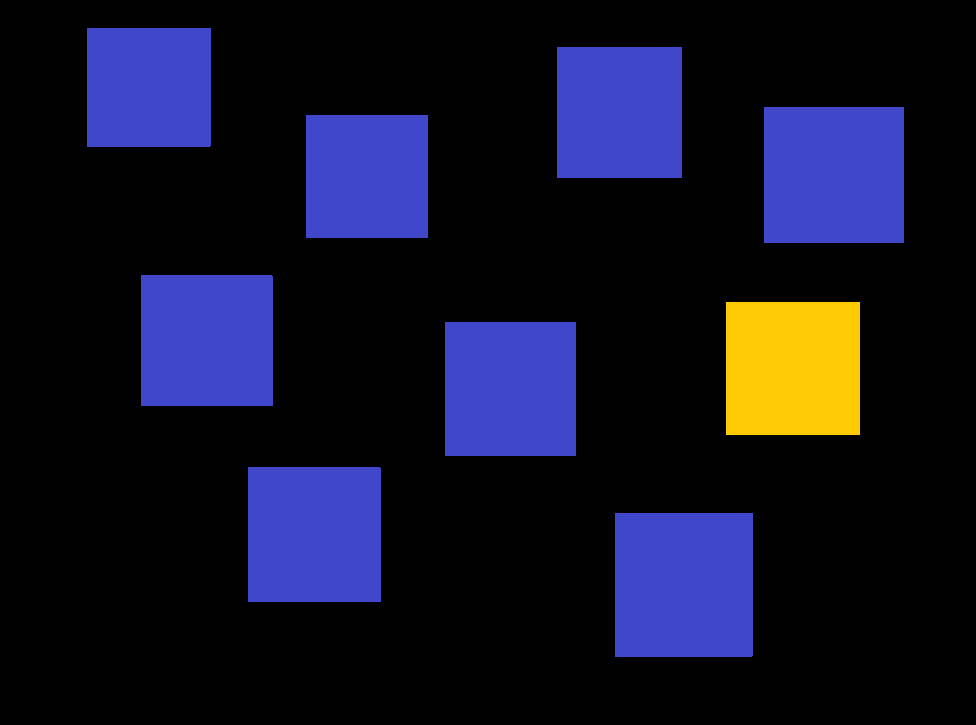
Memory for sequences of locations has its own classic test. In the early 1970s, Philip Corsi, a graduate student working with neuropsychologist Brenda Milner at McGill University, developed the Corsi block-tapping test[7]. Nine wooden blocks are fixed to a board. The examiner taps some of them in a sequence, and the person taps the same blocks in the same order. Sequences get longer until the person can no longer repeat them. The longest sequence they can reliably reproduce is their Corsi span, the spatial counterpart of digit span. The test is still widely used in neuropsychology, with standardized procedures and normative data[8]. In healthy adults, Corsi span is usually around five or six blocks.
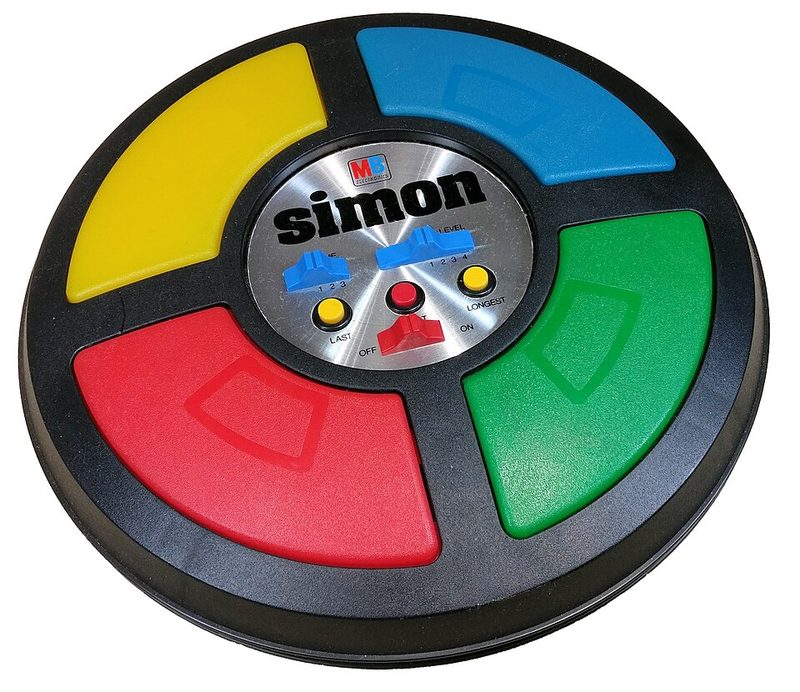
A few years later, in 1978, the electronic game Simon, designed by Ralph Baer and Howard Morrison, brought the same idea into living rooms: four colored buttons light up in a growing sequence that you copy. The Sequence Memory Test on this site follows the Simon format on a 3×3 grid. There’s one important difference from the Corsi test. In Simon-style games the sequence is cumulative, with each round replaying the previous sequence plus one new step. Because you only have to learn one new step at a time, and you rehearse the rest every round, you can often go well beyond your Corsi span.
What happens in the brain
Brain imaging and recordings show that holding information in mind involves coordinated activity across the prefrontal cortex, which maintains goals and controls attention, and the parietal cortex, which is heavily involved in spatial information. Sensory areas that originally processed the information also help keep it active. Current theories see working memory less as a single storage box and more as attention directed at internal representations[9]. That helps explain why distraction is so destructive to working memory: pull attention away, and the information fades within seconds.
Why working memory matters
Working memory supports almost everything that involves thinking in steps: following conversations and instructions, understanding long sentences, mental arithmetic, planning, and reasoning. It matters especially in learning. In one longitudinal study, children’s working memory at age 5 was a better predictor of their reading and math attainment six years later than their IQ scores[10].
Can you train it? What the research really shows
Given how important working memory is, it’s natural to hope that training it could make you smarter overall. In 2008, a study reported that practicing a demanding memory task called the “dual n-back” improved performance on a test of fluid intelligence[11]. It helped fuel a boom in commercial brain-training apps.
Larger studies have been more sobering. In a 2010 experiment run with a BBC television program, 11,430 people trained online for six weeks. They improved on the tasks they practiced, but there was no evidence of improvement on untrained tasks, even closely related ones[12]. A 2013 meta-analysis found that working memory training produces short-term gains on similar memory tasks but no convincing, lasting benefits for broader abilities such as reasoning, reading, or arithmetic[13]. A comprehensive 2016 review reached a similar conclusion: training reliably improves the trained task, with little good evidence of far-reaching transfer[14]. That same year, the maker of a popular brain-training app agreed to a $2 million settlement with the U.S. Federal Trade Commission over claims about its benefits.
None of this means memory games are pointless. It means the benefits are specific: you get better at the game, you learn strategies, and you exercise focused attention. It’s just not a shortcut to a higher IQ.
How sequence memory practice can benefit you
- Better strategies. Like SF, you’ll improve most by finding smarter ways to encode information, such as seeing shapes, grouping steps, and naming positions. These habits carry over to everyday tasks like remembering phone numbers, directions, or shopping lists.
- Practice with full focus. One lapse of attention ends the round, so the game rewards the kind of undistracted concentration that everyday life rarely demands.
- Knowing your limits. Seeing how quickly a sequence overwhelms you is a useful reminder to write things down, break instructions into steps, and avoid multitasking when the details matter.
- Staying mentally active. People who stay mentally engaged tend to keep their thinking skills better as they age. Cause and effect is hard to untangle, but challenging your mind in enjoyable ways is a reasonable habit.
Tips for longer sequences
Try tracing the path the lit tiles make, as if you were drawing a shape, instead of memorizing isolated positions. Break longer sequences into groups of three or four. Quietly naming the positions adds a verbal backup to your visual memory. Lower the speed while you’re learning, since there’s no shame in giving your brain time to encode, and take a short break between attempts when you notice your focus slipping. Ready to try? Open the Sequence Memory Test.
Try it yourself
Put the science into practice with this free exercise — no sign-up, right in your browser.
References
- Baddeley, A. D., & Hitch, G. (1974). Working memory. In G. A. Bower (Ed.), Recent Advances in Learning and Motivation (Vol. 8, pp. 47–89). Academic Press. doi:10.1016/S0079-7421(08)60452-1
- Baddeley, A. (2000). The episodic buffer: A new component of working memory? Trends in Cognitive Sciences, 4(11), 417–423. doi:10.1016/S1364-6613(00)01538-2
- Miller, G. A. (1956). The magical number seven, plus or minus two: Some limits on our capacity for processing information. Psychological Review, 63(2), 81–97. doi:10.1037/h0043158
- Cowan, N. (2001). The magical number 4 in short-term memory: A reconsideration of mental storage capacity. Behavioral and Brain Sciences, 24(1), 87–114. doi:10.1017/S0140525X01003922
- Chase, W. G., & Simon, H. A. (1973). Perception in chess. Cognitive Psychology, 4(1), 55–81. doi:10.1016/0010-0285(73)90004-2
- Ericsson, K. A., Chase, W. G., & Faloon, S. (1980). Acquisition of a memory skill. Science, 208(4448), 1181–1182. doi:10.1126/science.7375930
- Corsi, P. M. (1972). Human memory and the medial temporal region of the brain [Doctoral dissertation]. McGill University.
- Kessels, R. P. C., van Zandvoort, M. J. E., Postma, A., Kappelle, L. J., & de Haan, E. H. F. (2000). The Corsi Block-Tapping Task: Standardization and normative data. Applied Neuropsychology, 7(4), 252–258. doi:10.1207/S15324826AN0704_8
- D’Esposito, M., & Postle, B. J. (2015). The cognitive neuroscience of working memory. Annual Review of Psychology, 66, 115–142. doi:10.1146/annurev-psych-010814-015031
- Alloway, T. P., & Alloway, R. G. (2010). Investigating the predictive roles of working memory and IQ in academic attainment. Journal of Experimental Child Psychology, 106(1), 20–29. doi:10.1016/j.jecp.2009.11.003
- Jaeggi, S. M., Buschkuehl, M., Jonides, J., & Perrig, W. J. (2008). Improving fluid intelligence with training on working memory. Proceedings of the National Academy of Sciences, 105(19), 6829–6833. doi:10.1073/pnas.0801268105
- Owen, A. M., Hampshire, A., Grahn, J. A., Stenton, R., Dajani, S., Burns, A. S., Howard, R. J., & Ballard, C. G. (2010). Putting brain training to the test. Nature, 465(7299), 775–778. doi:10.1038/nature09042
- Melby-Lervåg, M., & Hulme, C. (2013). Is working memory training effective? A meta-analytic review. Developmental Psychology, 49(2), 270–291. doi:10.1037/a0028228
- Simons, D. J., Boot, W. R., Charness, N., Gathercole, S. E., Chabris, C. F., Hambrick, D. Z., & Stine-Morrow, E. A. L. (2016). Do “brain-training” programs work? Psychological Science in the Public Interest, 17(3), 103–186. doi:10.1177/1529100616661983
This article is for general education and isn’t medical advice. The exercises on this site are general wellness tools, not diagnostic tests or treatments — see the Disclaimer for details. Spotted an error or a newer study we should know about? Let us know.
More articles
- Reflexes · 7 min readThe Science of Reaction Time: Why Milliseconds Matter
- Eye training · 6 min readSmooth Pursuit: How Your Eyes Follow a Moving Target
- Eye training · 7 min readPeripheral Vision and Visual Attention: Seeing More Than You Look At
- Focus · 7 min readThe Schulte Table: The Science of Visual Search and Focus
- Math · 6 min readMental Math: What Happens in Your Brain When You Calculate
- Breathing · 7 min readBox Breathing and 4-7-8 Breathing: The Science of Slow Breathing