Peripheral Vision and Visual Attention: Seeing More Than You Look At
Why only a tiny patch of your vision is sharp, how saccades and attention fill in the rest, and what research on the useful field of view and multiple object tracking says about training awareness.
7 min read · Published September 17, 2026
At a glance
- Only the center of your vision is sharp. Peripheral vision is blurry but very good at detecting movement and sudden changes, so it acts as an early-warning system.
- Attention can shift to a spot without your eyes moving. Psychologists call this covert attention, and it decides much of what you notice.
- Things that suddenly appear grab attention automatically. Noticing them without being pulled away from your goal is a skill you can practice.
- In a large trial of older adults, training visual processing speed was linked to fewer at-fault car crashes. The benefits are strongest for tasks similar to the training.
You’re driving, eyes on the car ahead, when something moves at the edge of your vision: a cyclist pulling out, or a ball rolling into the road. You notice it before you look at it. That early warning comes from peripheral vision working together with attention, the brain’s system for choosing what gets processed. Much of what we call “awareness” depends on how well these two work together.
Two kinds of vision in every eye
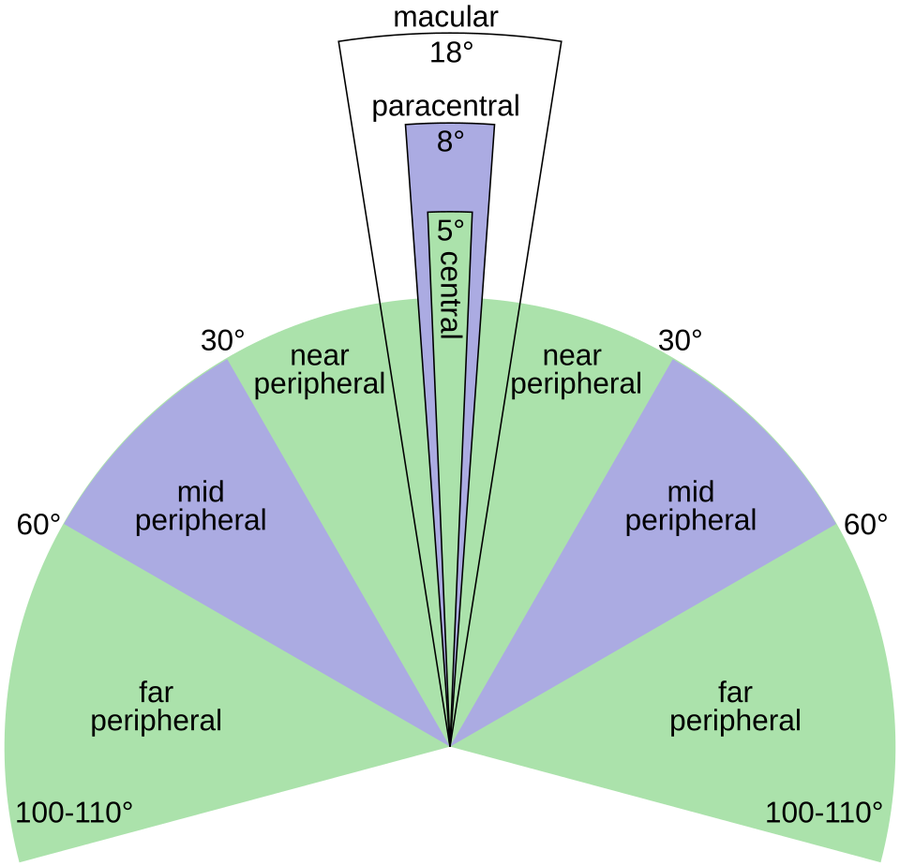
The retina isn’t uniform. Its center, the fovea, is packed with cone cells and gives sharp, colorful detail, but it covers only a thumbnail-sized patch of the world at arm’s length. Moving outward, cones thin out and rod cells take over. Rods are poor at detail and color but excellent in dim light and very sensitive to motion and flicker.
So each eye really has two systems in one. The center is for looking at things; the periphery is for noticing that something is there. Together your two eyes cover a horizontal field of more than 180 degrees, but you see only a small part of that clearly at any moment. To inspect something, you have to move your eyes to it.
Saccades: how your eyes jump
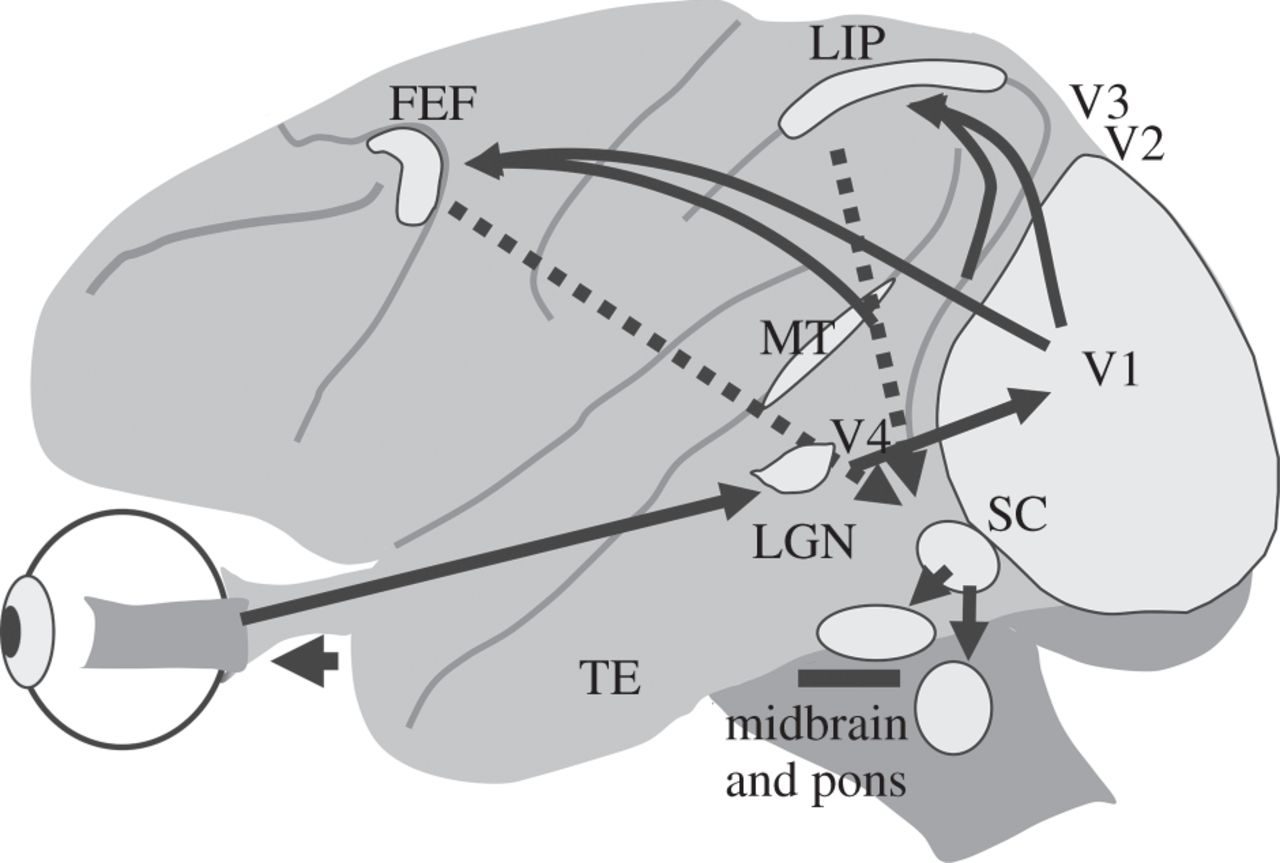
The eye movements that bring things into central vision are called saccades, from the French for “jerk.” In the late 1870s, researchers in the Paris laboratory of ophthalmologist Louis Émile Javal noticed that a reader’s eyes don’t glide along a line of text. They move in quick jumps separated by brief pauses. That turned out to be true of almost all looking.
You make about three saccades every second. They’re among the fastest movements the body produces, and each one usually takes a few tens of milliseconds. Starting one takes longer: roughly 200 milliseconds from when something appears to when your eyes begin moving toward it. Your brain also dims visual processing during each jump, which is why you don’t see the world smear every time your eyes move. In Random Pops, each new target is a cue for exactly this: detect it in the periphery, then jump to it.
Attention: a spotlight that moves without your eyes
In 1980 the psychologist Michael Posner published a series of simple experiments. People kept their eyes fixed on a central point while a cue hinted at where a target might appear. They detected targets faster at the cued location, even though their eyes never moved[1]. Attention had shifted on its own. This covert attention is often compared to a spotlight that can move around your visual field, making whatever it lights up easier to see.
That spotlight is steered in two ways. Goal-driven (top-down) attention follows what you’re trying to do, like looking for a friend’s red coat in a crowd. Stimulus-driven (bottom-up) attention gets pulled by things that stand out, like a sudden flash or movement. Brain imaging suggests these rely on partly separate networks. A dorsal network in the frontal and parietal lobes directs goal-driven attention, and a more right-sided ventral network acts as a “circuit breaker” when something important appears unexpectedly[2].
Objects that suddenly appear are especially good at capturing attention. Experiments in the 1980s showed that abrupt onsets draw attention automatically, even when they aren’t relevant to the task[3]. The reverse can happen too: if your attention is locked onto one thing, you can miss something obvious. In the famous “invisible gorilla” study, roughly half the viewers who were counting basketball passes failed to notice a person in a gorilla suit walking through the scene[4].
Random Pops puts both systems to work. When you pick one colored ball to follow, you’re using goal-driven attention. Every other ball popping up is a stimulus-driven distraction trying to pull you away. Learning to register those pops without getting hijacked by them is the core skill.
How many things can you track at once?
In 1988 Zenon Pylyshyn and Ron Storm showed people a screen of identical moving dots, briefly flashed some of them as targets, and asked people to keep track of those targets as everything moved. Participants could follow several targets at once, typically up to about four or five, before accuracy dropped sharply[5]. This task, called multiple object tracking, has become a standard way to study the limits of attention.
It has also found its way into sport. In a study of 308 people, professional athletes learned a demanding 3D multiple-object-tracking task much faster than amateur athletes, who in turn learned faster than non-athlete students. The task had nothing to do with any sport[6]. This suggests that tracking many things at once is a real skill, and one that differs a lot between people.
The useful field of view
Perhaps the most practical research in this area concerns the useful field of view (UFOV): the area around your point of gaze from which you can quickly take in information in a single glance, without moving your eyes or head. Unlike your raw visual field, the UFOV shrinks when you’re distracted, stressed, or tired, and it tends to narrow with age.
That narrowing matters on the road. In a study of nearly 300 older drivers, those with a substantial reduction in useful field of view were about twice as likely to crash over the next three years[7]. This led to a bigger question: can training help?
The ACTIVE trial tested this with 2,832 adults aged 65 and older, who were randomly assigned to training in memory, reasoning, or visual processing speed, or to no training. Each program improved the ability it targeted, and speed-of-processing training produced large improvements on speed tasks[8]. Over roughly six years of follow-up, drivers who received speed or reasoning training had lower rates of at-fault crashes than controls[9]. A ten-year analysis reported that speed training was associated with about a 29% lower risk of dementia[10]. That result is promising, but it comes from a single trial and still needs independent replication.
Younger people show trainability too. Frequent players of fast action video games outperformed non-players on several attention tasks, including a useful field of view test. When non-players trained for 10 hours on an action game, their attention scores improved more than those of a group that trained on a puzzle game[11].
How this kind of training can benefit you
- Situational awareness. Driving, cycling, crossing busy streets, and team sports all depend on noticing what’s happening at the edges while focusing on what’s in front of you.
- Resistance to distraction. Deliberately ignoring the balls you’re not tracking is practice for keeping focus when your environment keeps interrupting.
- Faster visual processing. Detecting and responding to brief targets exercises the same speed that the ACTIVE trial trained, though a casual game isn’t the same as that structured research program.
- A realistic view of your limits. Adding balls one at a time shows you exactly where your attention starts to break down. That’s a useful reminder that nobody can watch everything at once.
Keep your expectations realistic. Across attention research, improvements are largest on the trained task and on tasks that closely resemble it. Think of this as practice for a specific skill, not as a general brain upgrade.
How to practice
Open Random Pops and start with a single ball at a comfortable speed. Pick one color and follow only that target. Once that feels easy, add a second ball and keep following your chosen color while noticing, but not chasing, the other one. For a harder variation, keep your eyes near the center of the screen and try to detect where your target appears using peripheral vision before you look. Keep sessions short, take breaks, and lower the speed if the flashing feels uncomfortable. If you have photosensitive epilepsy, check the disclaimer before using any flashing exercise.
Try it yourself
Put the science into practice with this free exercise — no sign-up, right in your browser.
References
- Posner, M. I. (1980). Orienting of attention. Quarterly Journal of Experimental Psychology, 32(1), 3–25. doi:10.1080/00335558008248231
- Corbetta, M., & Shulman, G. R. (2002). Control of goal-directed and stimulus-driven attention in the brain. Nature Reviews Neuroscience, 3(3), 201–215. doi:10.1038/nrn755
- Yantis, S., & Jonides, J. (1984). Abrupt visual onsets and selective attention: Evidence from visual search. Journal of Experimental Psychology: Human Perception and Performance, 10(5), 601–621. doi:10.1037/0096-1523.10.5.601
- Simons, D. J., & Chabris, C. F. (1999). Gorillas in our midst: Sustained inattentional blindness for dynamic events. Perception, 28(9), 1059–1074. doi:10.1068/p281059
- Pylyshyn, Z. W., & Storm, R. W. (1988). Tracking multiple independent targets: Evidence for a parallel tracking mechanism. Spatial Vision, 3(3), 179–197. doi:10.1163/156856888X00122
- Faubert, J. (2013). Professional athletes have extraordinary skills for rapidly learning complex and neutral dynamic visual scenes. Scientific Reports, 3, 1154. doi:10.1038/srep01154
- Owsley, C., Ball, K., McGwin, G., Sloane, M. E., Roenker, D. L., White, M. F., & Overley, E. T. (1998). Visual processing impairment and risk of motor vehicle crash among older adults. JAMA, 279(14), 1083–1088. doi:10.1001/jama.279.14.1083
- Ball, K., Berch, D. B., Helmers, K. F., Jobe, J. B., Leveck, M. D., Marsiske, M., … Willis, S. L. (2002). Effects of cognitive training interventions with older adults: A randomized controlled trial. JAMA, 288(18), 2271–2281. doi:10.1001/jama.288.18.2271
- Ball, K., Edwards, J. D., Ross, L. A., & McGwin, G. (2010). Cognitive training decreases motor vehicle collision involvement of older drivers. Journal of the American Geriatrics Society, 58(11), 2107–2113. doi:10.1111/j.1532-5415.2010.03138.x
- Edwards, J. D., Xu, H., Clark, D. O., Guey, L. T., Ross, L. A., & Unverzagt, F. W. (2017). Speed of processing training results in lower risk of dementia. Alzheimer’s & Dementia: Translational Research & Clinical Interventions, 3(4), 603–611. doi:10.1016/j.trci.2017.09.002
- Green, C. S., & Bavelier, D. (2003). Action video game modifies visual selective attention. Nature, 423(6939), 534–537. doi:10.1038/nature01647
This article is for general education and isn’t medical advice. The exercises on this site are general wellness tools, not diagnostic tests or treatments — see the Disclaimer for details. Spotted an error or a newer study we should know about? Let us know.
More articles
- Reflexes · 7 min readThe Science of Reaction Time: Why Milliseconds Matter
- Eye training · 6 min readSmooth Pursuit: How Your Eyes Follow a Moving Target
- Focus · 7 min readThe Schulte Table: The Science of Visual Search and Focus
- Memory · 6 min readWorking Memory: How Much Can Your Mind Hold at Once?
- Math · 6 min readMental Math: What Happens in Your Brain When You Calculate
- Breathing · 7 min readBox Breathing and 4-7-8 Breathing: The Science of Slow Breathing