Measuring Body Fat: What the Tape, the Scale, and the Scanner Tell You
Why BMI misses so much, how body fat is measured — from underwater weighing to DEXA scans and the Navy tape method — how accurate each method is, and what a healthy range looks like.
7 min read · Published September 18, 2026
At a glance
- Body weight and BMI can’t tell fat from muscle. Standard BMI cut-offs miss about half of people who have excess body fat.
- No everyday method measures body fat directly. Underwater weighing, DEXA scans, smart scales, skinfold calipers, and tape measures all estimate it, each with its own errors.
- The U.S. Navy tape method needs only a tape measure. In a recent study of 609 Marines, it came within about 2–3 percentage points of DEXA scans on average, but individual results varied more.
- Whatever method you use, measuring the same way over time and watching the trend tells you far more than any single number.
Your bathroom scale tells you how much you weigh, but not what that weight is made of. Two people of the same height and weight can look completely different: one with more muscle, the other with more fat. For health and fitness, body composition — how much of you is fat and how much is lean tissue — often matters more than weight itself. Here’s how scientists learned to measure it, how accurate the common methods really are, and how to use them sensibly.
Why weight and BMI aren’t enough
The body mass index (BMI) divides your weight by the square of your height. It’s quick and free, and across large populations it tracks health risk reasonably well. But it can’t tell where your weight comes from. A 2010 meta-analysis of 25 studies covering about 32,000 people compared BMI with direct measurements of body fat. The standard BMI cut-offs were good at confirming excess fat when they flagged it, but they missed about half of the people who actually had excess body fat[1]. Many people with a “normal” BMI carry more fat than is healthy, and some muscular people are labeled overweight when they’re lean.
A brief history: from average men to Navy divers
The formula behind BMI is older than you might expect. In 1832, the Belgian mathematician and statistician Adolphe Quetelet noticed that among adults, weight tends to rise with the square of height. For more than a century his ratio was known as the Quetelet index[2]. In 1972 the American physiologist Ancel Keys and colleagues compared several weight-for-height indices in thousands of men and concluded that Quetelet’s ratio worked best. They gave it a new name: the body mass index[3]. One of Keys’s co-authors was the Finnish scientist Martti Karvonen, whose heart rate formula is described in our article on heart rate training.
Measuring fat itself took a different path. In the early 1940s, the U.S. Navy physician Albert Behnke applied Archimedes’ principle to people. Fat is less dense than muscle and bone, so a person with more fat weighs relatively less when submerged in water. By weighing people on land and underwater, Behnke’s team calculated body density and used it as an index of obesity[4]. In a companion study, they measured 25 professional football players — heavy men who looked overweight on height-weight tables — and showed that they were actually dense and lean[5]. A widely repeated story says 17 of those players would have been rejected by the military as overweight. That detail is best treated as legend, but the point stands: the players were estimated to average less than 10% body fat[6]. Being heavy and being fat are not the same thing.
How body fat is measured
Nearly every method estimates body fat indirectly. Most of them divide the body into two parts, fat mass and fat-free mass, and use a measurable property — density, X-ray absorption, electrical resistance, skinfold thickness, or body shape — to estimate the split[7].
- Underwater weighing (hydrodensitometry). Behnke’s method was the reference standard for decades. It’s accurate in a lab, but you have to breathe out fully and sit still underwater, and it assumes everyone’s lean tissue has the same density, which isn’t quite true.
- Air displacement (the Bod Pod). The same density principle, using air pressure in a sealed capsule instead of water.
- DEXA (dual-energy X-ray absorptiometry). A low-dose X-ray scan that separates bone, fat, and lean tissue, and shows where fat is stored. It’s widely used in research and clinics, though it isn’t a perfect gold standard either.
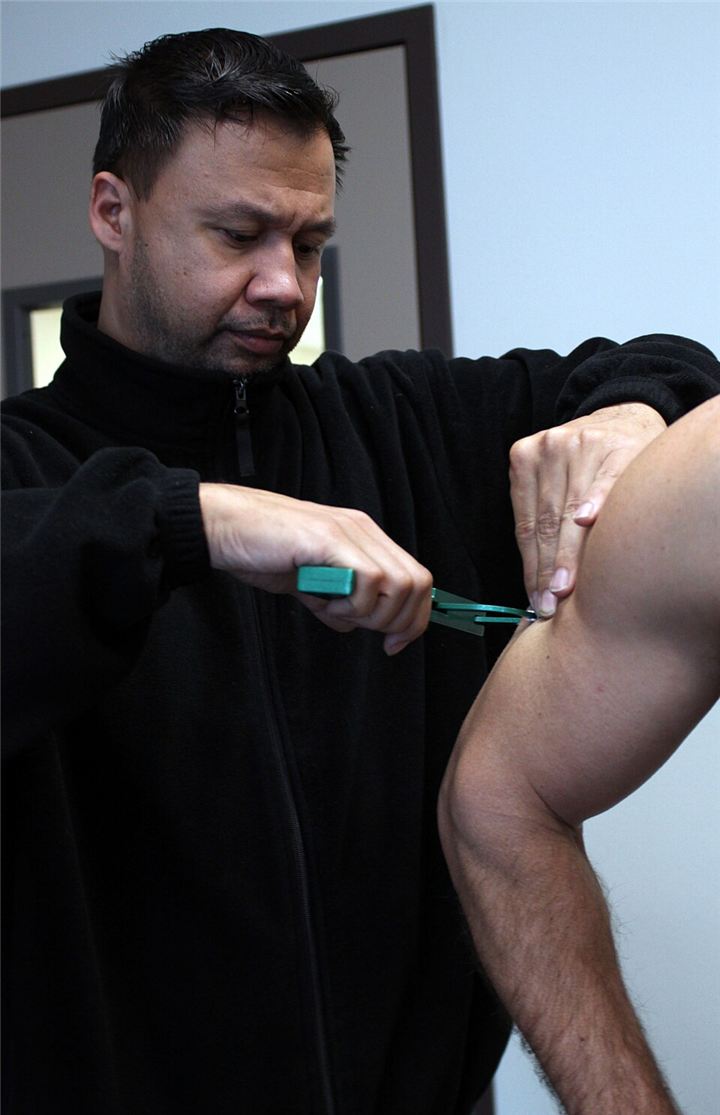
- Skinfold calipers. A trained tester pinches and measures folds of skin and fat at several sites, then uses an equation to estimate body density. The widely used Jackson–Pollock equations were developed in 308 men and checked in a separate group of 95[8]. Accuracy depends heavily on the tester’s skill.
- Bioelectrical impedance (smart scales and handheld devices). A tiny, harmless electrical current passes through your body. Lean tissue holds more water and conducts electricity better than fat, so resistance is used to estimate fat-free mass. The method works best under standardized conditions, because hydration strongly affects the reading[9]. A big drink of water or a workout can shift the result.
- Circumference methods. Tape measurements of the neck, waist, and hips, combined with height, feed an equation. That’s the approach behind the U.S. Navy method.
The Navy tape method: how good is it?
Military services need to check body fat quickly in large numbers of people, often without a lab. In 1984, James Hodgdon and Marcie Beckett at the Naval Health Research Center in San Diego developed equations that estimate body fat from height and a few tape measurements: neck and waist for men, and neck, waist, and hips for women[10]. The logic is simple. Fat tends to collect around the waist and hips, while neck size reflects overall frame and muscle. The equations turn those measurements into an estimate of body density, and from there into body fat percentage.
How well does it hold up against modern scanners? In a 2022 study of 609 U.S. Marines — 430 men and 179 women — researchers compared circumference estimates with DEXA scans. The tape method underestimated men’s body fat by about 2.6 percentage points on average and overestimated women’s by about 1.3–2.3 points. Individual results were more scattered, with a spread (standard deviation) of roughly 4 percentage points around those averages[11].
In plain terms: the tape method gives a reasonable estimate for a group, and it can be a few points off for any one person. That’s similar to many field methods, and it’s why the most useful thing about the tape method is tracking your own change over time with the same technique.
What’s a healthy body fat percentage?
There’s no single agreed standard. Fitness charts, such as the American Council on Exercise categories used by the calculator on this site, divide results into bands like athletes, fitness, average, and obese. Researchers have tried to set healthy ranges more rigorously. A study of 1,626 adults led by Dympna Gallagher linked body fat to the BMI thresholds for underweight, overweight, and obesity, and found that the matching body fat levels depend on sex, age, and ethnic background[12]. Women naturally carry more essential fat than men, so their healthy ranges are higher.
Where fat is stored matters too. Fat deep inside the abdomen, around the organs, is more strongly linked to heart disease and type 2 diabetes than fat under the skin. In 2020, an international expert panel concluded that BMI alone isn’t enough to judge this risk and recommended that doctors measure waist circumference routinely, as a “vital sign.” They also noted that regular moderate exercise and dietary changes can shrink waist size meaningfully[13].
How measuring body fat can benefit you
- Seeing progress the scale hides. If you start strength training, you may gain muscle while losing fat. Your weight may barely change, but your body fat estimate and waist measurement will.
- Better goals than a number on the scale. Aiming to lower body fat or waist size keeps attention on health rather than weight alone.
- Protecting muscle while dieting. Tracking body fat alongside weight shows whether you’re losing fat or muscle, which can prompt you to eat more protein or add strength training.
- A cheap check on health risk. A tape measure around your waist is one of the simplest ways to keep an eye on the fat that matters most for heart health.
Getting reliable measurements at home
For the tape method, use a flexible tape against bare skin, snug but not compressing. Measure the neck just below the Adam’s apple and the waist at the navel for men, or at the narrowest point for women, plus the widest point of the hips. Stand relaxed and don’t pull your stomach in. Take each measurement two or three times and use the average, and measure at the same time of day, ideally in the morning. Then enter the numbers in the Body Fat Calculator, and compare with the BMI Calculator to see how the two views differ.
Recheck every few weeks rather than every day, since real changes in body fat are slow. If you’re trying to lose fat, our articles on weight loss and metabolism and macronutrients explain how to do it while keeping as much muscle as possible, and progressive overload covers the strength training that helps build it.
Try it yourself
Put the science into practice with these free tools — no sign-up, right in your browser.
References
- Okorodudu, D. O., Jumean, M. F., Montori, V. M., Romero-Corral, A., Somers, V. K., Erwin, P. J., & Lopez-Jimenez, F. (2010). Diagnostic performance of body mass index to identify obesity as defined by body adiposity: A systematic review and meta-analysis. International Journal of Obesity, 34(5), 791–799. doi:10.1038/ijo.2010.5
- Eknoyan, G. (2008). Adolphe Quetelet (1796–1874) — the average man and indices of obesity. Nephrology Dialysis Transplantation, 23(1), 47–51. doi:10.1093/ndt/gfm517
- Keys, A., Fidanza, F., Karvonen, M. J., Kimura, N., & Taylor, H. L. (1972). Indices of relative weight and obesity. Journal of Chronic Diseases, 25(6–7), 329–343. doi:10.1016/0021-9681(72)90027-6
- Behnke, A. R., Feen, B. G., & Welham, W. C. (1942). The specific gravity of healthy men: Body weight ÷ volume as an index of obesity. Journal of the American Medical Association, 118(7), 495–498. doi:10.1001/jama.1942.02830070001001
- Welham, W. C., & Behnke, A. R. (1942). The specific gravity of healthy men: Body weight ÷ volume and other physical characteristics of exceptional athletes and of naval personnel. Journal of the American Medical Association, 118(7), 498–501. doi:10.1001/jama.1942.02830070004002
- Friedl, K. E. (1990). Body composition and military performance: Origins of the Army standards. In B. M. Marriott & J. Grumstrup-Scott (Eds.), Body composition and physical performance: Applications for the military services. National Academies Press. Link
- Wagner, D. R., & Heyward, V. H. (1999). Techniques of body composition assessment: A review of laboratory and field methods. Research Quarterly for Exercise and Sport, 70(2), 135–149. doi:10.1080/02701367.1999.10608031
- Jackson, A. S., & Pollock, M. L. (1978). Generalized equations for predicting body density of men. British Journal of Nutrition, 40(3), 497–504. doi:10.1079/BJN19780152
- Kyle, U. G., Bosaeus, I., De Lorenzo, A. D., Deurenberg, P., Elia, M., Gómez, J. M., Heitmann, B. L., Kent-Smith, L., Melchior, J.-C., Pirlich, M., Scharfetter, H., Schols, A. M. W. J., & Pichard, C. (2004). Bioelectrical impedance analysis — part I: Review of principles and methods. Clinical Nutrition, 23(5), 1226–1243. doi:10.1016/j.clnu.2004.06.004
- Hodgdon, J. A., & Beckett, M. B. (1984). Prediction of percent body fat for U.S. Navy men from body circumferences and height (Report No. 84-11). Naval Health Research Center. Link
- Potter, A. W., Tharion, W. J., Holden, L. D., Pazmino, A., Looney, D. P., & Friedl, K. E. (2022). Circumference-based predictions of body fat revisited: Preliminary results from a US Marine Corps body composition survey. Frontiers in Physiology, 13, 868627. doi:10.3389/fphys.2022.868627
- Gallagher, D., Heymsfield, S. B., Heo, M., Jebb, S. A., Murgatroyd, P. R., & Sakamoto, Y. (2000). Healthy percentage body fat ranges: An approach for developing guidelines based on body mass index. The American Journal of Clinical Nutrition, 72(3), 694–701. doi:10.1093/ajcn/72.3.694
- Ross, R., Neeland, I. J., Yamashita, S., Shai, I., Seidell, J., Magni, P., Santos, R. D., Arsenault, B., Cuevas, A., Hu, F. B., Griffin, B. A., Zambon, A., Barter, P., Fruchart, J.-C., Eckel, R. H., Matsuzawa, Y., & Després, J.-P. (2020). Waist circumference as a vital sign in clinical practice: A Consensus Statement from the IAS and ICCR Working Group on Visceral Obesity. Nature Reviews Endocrinology, 16(3), 177–189. doi:10.1038/s41574-019-0310-7
This article is for general education and isn’t medical advice. The exercises and calculators on this site are general wellness tools, not diagnostic tests or treatments — see the Disclaimer for details. Spotted an error or a newer study we should know about? Let us know.
More articles
- Reflexes · 7 min readThe Science of Reaction Time: Why Milliseconds Matter
- Eye training · 6 min readSmooth Pursuit: How Your Eyes Follow a Moving Target
- Eye training · 7 min readPeripheral Vision and Visual Attention: Seeing More Than You Look At
- Focus · 7 min readThe Schulte Table: The Science of Visual Search and Focus
- Memory · 6 min readWorking Memory: How Much Can Your Mind Hold at Once?
- Math · 6 min readMental Math: What Happens in Your Brain When You Calculate
- Breathing · 7 min readBox Breathing and 4-7-8 Breathing: The Science of Slow Breathing
- Training · 9 min readHeart Rate Training: The Science of Zones and the Karvonen Formula
- Training · 7 min readPacing Strategy: The Science of Running Your Best Race
- Nutrition · 7 min readProtein, Carbs, and Fat: The Science of Macronutrients
- Nutrition · 7 min readWhy Weight Loss Slows Down: The 3,500-Calorie Rule and Your Metabolism
- Training · 7 min readProgressive Overload: The Science of Getting Stronger